Qoyod Review (2026): ZATCA Accounting for Saudi SMEs
lkwjd Editorial TeamJuly 30, 202612 min read
LE
lkwjd Editorial TeamIndependent software reviews for Middle East businesses
This article may contain affiliate links. If you purchase through these links, we may earn a commission at no extra cost to you. This helps support our independent reviews.
Key Takeaways
Qoyod publishes its prices — a rarity in Saudi business software. Its own plans page lists Basic at SAR 138/month, Pro at SAR 207/month and Advanced at SAR 379.50/month, VAT included.
It is ZATCA Phase 2 certified: invoices are generated as UBL XML, cryptographically stamped, cleared through the Fatoora platform and returned as a PDF/A-3 with the XML embedded — with no separate connector to buy.
The headline price is not the whole price. POS is SAR 50/user/month, payroll SAR 10/employee/month, extra users SAR 20 each and extra locations SAR 40 each — a five-branch retailer lands well above the sticker.
Q.Flavours, Qoyod's restaurant POS built on its acquisition of Flavors, adds offline mode, digital menus and ingredient-level stock — genuinely useful if you run food and beverage.
Qoyod is built for Saudi SMEs, not multinationals. Multi-country consolidation, deep warehouse management and mature automatic bank feeds are where you should look elsewhere.
What Qoyod Actually Is
Qoyod is a Saudi-built cloud accounting platform aimed squarely at the SME layer of the Kingdom's economy — the shops, contractors, clinics and agencies that need clean books and a compliant invoice, not a general ledger designed in Walldorf.
It is worth being precise about the category, because Qoyod gets described three different ways depending on who is selling it. It is not an ERP in the Odoo or SAP sense. It is not a point-of-sale company that grew an accounting module. It is an accounting product first — chart of accounts, journals, VAT, receivables, payables — that has extended outward into inventory, point of sale, payroll and, most recently, restaurant operations.
OriginSaudi-built, Arabic-first
Reported Users25,000+ businesses (vendor-stated)
ComplianceZATCA Phase 2 certified
Entry PriceSAR 138/month incl. VAT
Qoyod states it serves more than 25,000 businesses across sectors including retail, services, healthcare, contracting and manufacturing. That is a vendor-reported figure and we have not independently audited it, but the size of its integration marketplace and the volume of Saudi-language help content around it are consistent with a large installed base rather than a marketing claim floated on nothing.
The reason it matters is hiring and support. In Saudi Arabia, a widely-used platform means your accountant has probably seen it, your bookkeeper can be trained on it in an afternoon, and support conversations happen in Arabic on Saudi business hours. That is not a feature you find on a comparison table, and it is frequently the difference between software that gets adopted and software that gets abandoned after four months.
ZATCA Phase 2: What Happens to Your Invoice
This is the part of the product that justifies its existence for a Saudi business, so it deserves more than a checkmark on a feature grid.
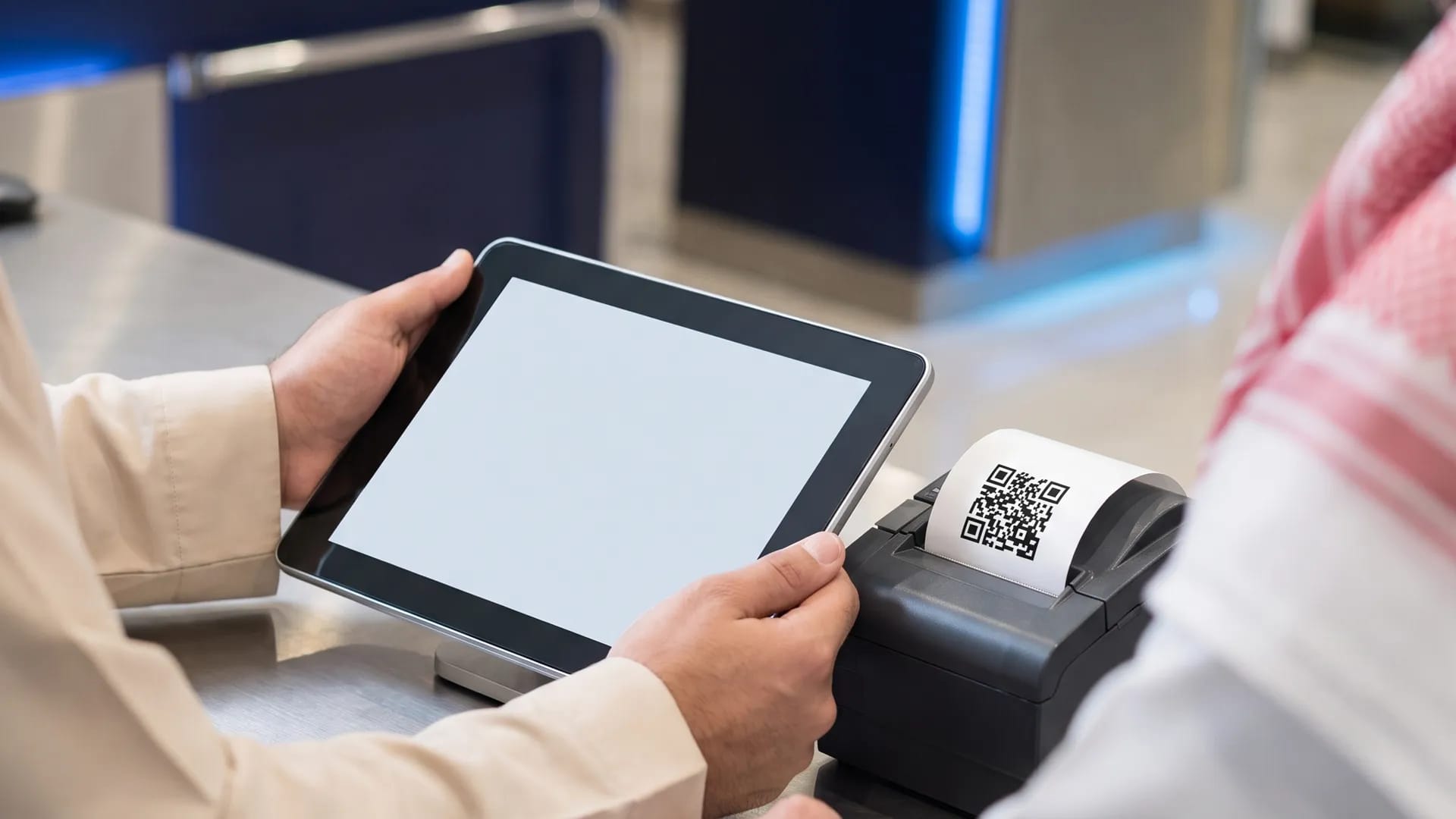
Under ZATCA's Phase 2 — the Integration Phase — an invoice is no longer a document you print. It is a structured record that must be generated in UBL XML, carry a QR code, be cryptographically stamped, and be transmitted to ZATCA's Fatoora platform. For standard tax invoices this happens as clearance: the invoice goes to ZATCA before it goes to your customer, and it is not legally valid until the Authority returns approval.
Qoyod is certified for Phase 2 and runs that whole pipeline internally. It generates the XML, signs it, submits it to Fatoora, receives back the clearance and a unique UUID, and delivers a PDF/A-3 invoice with the XML embedded inside the file. For the person issuing the invoice, this is invisible: you click save and the compliance happens underneath.
The practical value here is what you are not buying. Plenty of businesses in the Kingdom have ended up with an accounting system plus a separate middleware connector plus an annual integration retainer, because their software was never designed for Saudi clearance and had compliance grafted on. Qoyod has no such seam. If you are choosing a platform in 2026, treat native, in-product clearance as a hard requirement, not a nice-to-have — the alternative costs real money every year and breaks in ways nobody owns.
The Accounting Core
Underneath the compliance story, Qoyod is a competent double-entry accounting system with the parts a Saudi SME actually touches every week.
You get a proper chart of accounts, journal entries, customer and supplier ledgers, quotations that convert to invoices, credit and debit notes, expense capture, multi-user permissions and the standard reporting set — profit and loss, balance sheet, trial balance, ageing, and VAT reporting formatted for ZATCA filing. Payroll is available as a paid add-on rather than a bundled module.
The interface is the quiet strength. Qoyod was designed in Arabic rather than translated into it, which shows up in the details that trip up localised international products: right-to-left layout that does not break under long Arabic entity names, Arabic item descriptions that render correctly on the cleared invoice rather than as boxes, and Hijri-aware date handling. Anyone who has watched an English-first product mangle an Arabic customer name on a printed tax invoice will understand why this is worth paying for.
What we like
Arabic-first interface and document output — not a translated skin over an English product
Full VAT reporting formatted for ZATCA filing, so the return is a report rather than a rebuild
Genuinely approachable for non-accountants, which matters when the owner does the books
A 14-day free trial with all features and no credit card required — you can test properly before committing
What to watch
Payroll is a paid add-on at SAR 10 per employee per month, not part of the base subscription
Reporting customisation is shallower than Zoho Books — if you want bespoke management reports, check this in the trial
Inventory and Point of Sale
Qoyod includes stock control tied directly to the ledger, plus a point-of-sale module sold per user. Both are good enough for a lot of businesses and wrong for a few.
The inventory module handles products and variants, stock levels across locations, purchase orders, stock movements and cost of goods sold posting straight into the accounts. Because the stock ledger and the accounting ledger are the same system, you avoid the month-end ritual of exporting one system's numbers to reconcile against another's. For a retailer, a small distributor or a clinic tracking consumables, this is the right shape.
It is not, however, a warehouse management system. There is no serious pick-path optimisation, no multi-step receiving routes, no manufacturing bill-of-materials depth of the kind Odoo offers. If your operation involves assembly, complex batch genealogy or a warehouse team working from handheld scanners all day, Qoyod will feel thin and you should be looking at a dedicated inventory or ERP platform instead. The honest framing is: Qoyod does inventory well enough to keep your accounts correct, not well enough to run a logistics operation.
What we like
Stock and accounts share one ledger — no export-and-reconcile at month end
Multi-location stock is supported natively, with locations sold as an add-on rather than a plan jump
POS ties into the same inventory and issues ZATCA-cleared invoices from the counter
What to watch
POS costs SAR 50 per user per month on top of your plan — it is not included
No real warehouse management depth: no advanced routes, no manufacturing BOM hierarchy
Batch and expiry handling is lighter than food or pharma distributors typically need — test it in the trial
Q.Flavours — The Restaurant Arm
Qoyod's most interesting recent move was not a feature release. It was buying its way into food and beverage.
Q.Flavours is Qoyod's cloud restaurant POS and management system, built out of its acquisition of the Flavors POS business. It covers orders, sales, branch management, reporting and tax invoicing, and — importantly for a restaurant — it tracks stock at ingredient level rather than at finished-product level, with automated low-stock alerts and supplier management on top.
Two details make it credible rather than an accounting company dabbling in hospitality. The first is offline mode: a restaurant POS that stops taking orders when the internet drops is not a restaurant POS, and Q.Flavours keeps operating through connectivity failures. The second is that it feeds directly into Qoyod Accounting, so a day's covers land in the general ledger without a spreadsheet in between and without the reconciliation gap that plagues restaurants running a POS and an accountant on separate islands.
Where does it sit against the incumbent? Foodics remains the deeper hospitality specialist in the Saudi market, with a broader hardware and delivery-integration story. Q.Flavours' argument is not that it beats a dedicated restaurant platform on features — it is that a single-brand cafe or a small multi-branch group gets POS, stock and compliant accounting from one vendor, one contract and one support line. For a two-branch coffee shop that is a genuinely strong case. For a fifty-branch quick-service group it probably is not.
Integrations and the Surrounding Ecosystem
An accounting system is only as useful as the things it can talk to, and this is an area where Saudi-built software has historically been weak.
Qoyod does reasonably well here. Through its integrations marketplace it connects to the e-commerce platforms Saudi merchants actually use — Salla, Zid, Shopify and WooCommerce — so online orders arrive as documents with the stock movement already applied rather than as a CSV somebody imports on Sunday. Payment gateway connections cover the local set, including Tamara, Tabby and Moyasar. There is also a public API for building your own integrations, plus Zapier connectivity for the long tail of tools that will never get a native connector.
The gap, and it is a market-wide gap rather than a Qoyod failing, is bank feeds. Automatic bank transaction import of the kind a UK or US business takes for granted is still immature in Saudi Arabia because the open banking framework under SAMA is only now maturing. Expect more manual bank reconciliation than you would in Xero or QuickBooks, and budget bookkeeping time accordingly. Ask the vendor directly which Saudi banks are supported today rather than assuming — this is a fast-moving area and the answer in six months will not be the answer now.
What we like
Native Salla and Zid connectors — the two platforms that matter most for Saudi e-commerce
Local payment gateway coverage including Tamara, Tabby and Moyasar
Public API plus Zapier, so bespoke workflows do not require the vendor's roadmap
What to watch
Bank feed automation is limited by the state of Saudi open banking — confirm your bank specifically
The connector catalogue is regional; if you rely on a global SaaS stack, check each tool individually
Where Qoyod Falls Short
No review is useful if it only lists strengths. These are the six things that would make us steer a business away from Qoyod, or at least slow down the purchase.
01
Add-ons stack fast
The plan price is a floor, not a ceiling. POS at SAR 50/user, payroll at SAR 10/employee, extra users at SAR 20 and extra locations at SAR 40 per month compound quickly. Model your real headcount and branch count before comparing headline prices with anyone else.
02
Not built for multi-country groups
If you operate across Saudi Arabia and the UAE or beyond, and you need consolidated multi-entity, multi-currency reporting, this is not the product's design centre. Zoho Books or a mid-market ERP will serve you better.
03
Migration scope is unclear until you ask
The public material does not commit to what can be migrated from your existing system. Before signing, get in writing which records transfer — opening balances, historical invoices, item masters, customer ledgers — whether it is self-service or assisted, and whether it is included in your plan.
04
Inventory depth has a ceiling
Adequate for retail and light distribution; insufficient for manufacturing, complex batch traceability or a real warehouse operation. If stock is the core of your business rather than a by-product of it, look at a dedicated platform.
05
Bank reconciliation stays manual
Until Saudi open banking matures further, expect to do more reconciliation by hand than the marketing implies. This is a cost in bookkeeping hours, and it applies to most local competitors too.
06
Published pricing is inconsistent across sources
Third-party roundups widely quote a flat SAR 199/month figure that does not match the three-tier structure on Qoyod's own plans page. Always price from the vendor's current page, and get the figure confirmed in your quote before you pay for a multi-year term.
Pricing in Full — Including the Add-Ons
Qoyod publishes its prices, which is genuinely unusual in this market and worth crediting. Here is the structure as listed on its own plans page, with VAT shown both ways so you can compare like for like.
Plan
Monthly (incl. VAT)
Monthly (ex. VAT)
Users
Locations
Basic
SAR 138
SAR 120
1
1
Pro
SAR 207
SAR 180
3
3
Advanced
SAR 379.50
SAR 330
5
5
On top of the plan sit four add-ons, each billed monthly: payroll at SAR 10 per employee, point of sale at SAR 50 per user, additional users at SAR 20 each and additional locations at SAR 40 each. A three-branch retailer on Pro running POS on four tills and paying twelve staff is therefore looking at roughly SAR 207 plus SAR 200 for POS plus SAR 120 for payroll — before any extra users. That is still competitive, but it is nearly triple the headline number, and it is the calculation most buyers skip.
Multi-year discounting is real and periodically aggressive. Qoyod has run offers such as 20% off Pro on a two-year commitment and 33% off Advanced on a three-year term, both paid upfront. Those are worth taking if you are confident in the platform — but only after the trial, never before. A discounted three-year contract on software you have used for a week is a bet, not a saving.
One caution on sources. A flat 'SAR 199 per month' figure circulates widely in third-party comparison articles and does not correspond to the tiers Qoyod currently publishes. Prices in this market move, offers come and go, and secondary sources go stale quickly. Price from the vendor's own page on the day you buy, and get the number written into your quote.
Alternatives Worth Comparing
Qoyod is a strong default for a Saudi SME, but it is not the only credible answer. These are the three platforms we would put on the same shortlist, with published pricing stated where it exists and marked clearly where it does not.
Platform
Best For
ZATCA Phase 2
Arabic
Entry Price
Rating
Qoyod
Saudi SMEs wanting one certified system
Certified
Native
SAR 138/mo incl. VAT
4.5
Wafeq
KSA + UAE businesses, free start
Approved
Native
Free tier available
4.4
Daftra
Arabic-first all-in-one business suite
Yes
Native
Tiered — confirm current SAR pricing
4.2
Zoho Books
Multi-country groups and deep reporting
Approved
Full
Free plan; tiers published for KSA
4.4
Wafeq
A ZATCA Phase 2 approved cloud accounting platform serving both Saudi Arabia and the UAE, covering invoicing, inventory, payroll and automated VAT returns generated in ZATCA format, with a free entry tier that lets a startup begin without a budget line.
The closest direct rival to Qoyod, and the better pick if you operate in both KSA and the UAE or want to start on a free plan.
Daftra
An Arabic-first cloud business suite that bundles invoicing, sales, POS, inventory, CRM, HR and payroll into one subscription with ZATCA Phase 2 integration, tiered so that features such as cost centres, price lists and purchasing management sit on higher plans.
Worth a demo if you want a single Arabic system for the entire business rather than accounting with modules attached.
Zoho Books
A ZATCA-approved Phase 2 solution with built-in Fatoora integration, full Arabic support and by far the deepest reporting and automation of anything on this list, sitting inside an ecosystem that includes CRM, Inventory and Analytics.
The right answer if you need multi-entity or multi-currency consolidation, or if you are standardising a growing group on one global vendor.
Our Verdict
Our Verdict on Qoyod
Qoyod is the software equivalent of a well-made local tool: it does the job the Saudi market actually needs, it tells you what it costs, and it does not pretend to be more than it is. For a Saudi SME under about fifty staff operating in one country, it is an easy shortlist entry and frequently the right buy.
Strongest dimension
ZATCA & E-Invoicing4.8 / 5
Phase 2 certification with the full XML, stamping, Fatoora clearance and PDF/A-3 pipeline handled in-product. Nothing to bolt on, nothing to renew separately.
Local fit
Arabic & Saudi Design4.7 / 5
Built in Arabic rather than translated into it, with local support hours and a large enough install base that trained staff and familiar accountants are easy to find.
Cost
Value for Money4.4 / 5
Published pricing from SAR 138/month including VAT is fair and rare. Marked down only because POS, payroll, users and locations are all separately billed add-ons.
Weakest dimension
Depth & Scalability3.6 / 5
Inventory stops short of warehouse management, multi-country consolidation is not the design centre, and bank feed automation is constrained by the wider Saudi market.
Buy it if you are a Saudi SME that wants compliant books, Arabic that works, and a price you can see before you talk to a salesperson. Do not buy it if you are consolidating entities across borders, running a real warehouse, or scaling past the point where per-user add-ons stop being trivial. And whatever you decide, use the full 14-day trial with your own data first — the trial is unrestricted, which means there is no excuse for buying on a demo.
Frequently Asked Questions
01How much does Qoyod cost per month?
Qoyod's own plans page lists three tiers including VAT: Basic at SAR 138 per month for one user and one location, Pro at SAR 207 per month for three users and three locations, and Advanced at SAR 379.50 per month for five users and five locations. Excluding VAT, that is SAR 120, SAR 180 and SAR 330 respectively. Add-ons are billed separately — payroll at SAR 10 per employee, POS at SAR 50 per user, extra users at SAR 20 each and extra locations at SAR 40 each, all per month. Note that a flat SAR 199 figure appears in many third-party articles and does not match the vendor's current published tiers, so price from Qoyod's own page.
02Is Qoyod ZATCA Phase 2 compliant?
Yes. Qoyod is certified for ZATCA Phase 2 and handles the full pipeline inside the product: it generates the invoice as UBL XML, applies the QR code and cryptographic stamp, transmits it to the Fatoora platform for clearance, receives the approval and unique UUID back, and delivers a PDF/A-3 invoice with the XML embedded. There is no separate connector or middleware to license, which is a meaningful cost and reliability advantage over stitching compliance onto a system that was not designed for it.
03Does Qoyod work for restaurants and cafes?
Yes, through Q.Flavours, Qoyod's restaurant POS and management system built from its acquisition of the Flavors POS business. It covers orders, sales, branch management, digital menus and ingredient-level inventory with automated stock alerts, runs in offline mode so service continues when connectivity drops, and feeds directly into Qoyod Accounting. For a single site or a small group it is a strong one-vendor option; a large quick-service chain is more likely to be better served by a dedicated hospitality platform such as Foodics.
04Qoyod or Wafeq — which should a Saudi SME choose?
They are close, and the deciding factors are geography and starting budget rather than raw features. Both are Arabic-native and ZATCA Phase 2 ready. Wafeq serves Saudi Arabia and the UAE and offers a free entry tier, which makes it the better fit if you operate in both markets or want to start without spending anything. Qoyod is the stronger single-market pick, particularly if you want POS and restaurant operations from the same vendor. Trial both with your own chart of accounts before deciding — a fortnight of real use tells you more than any comparison table.
05Can Qoyod connect to Salla, Zid and my bank?
Salla and Zid both have native connectors, alongside Shopify and WooCommerce, plus local payment gateways including Tamara, Tabby and Moyasar, a public API and Zapier support. Bank connectivity is the weaker area — automatic bank feeds are still immature across the Saudi market because open banking under SAMA is only now maturing, so expect more manual reconciliation than in a UK or US product. Ask specifically which Saudi banks are supported for your accounts today rather than assuming, since this is changing quickly.
Share this article:
Never Pick the
Wrong Tool Again.
Get weekly expert recommendations, honest comparisons, and exclusive guides — tailored for the Middle East market.