
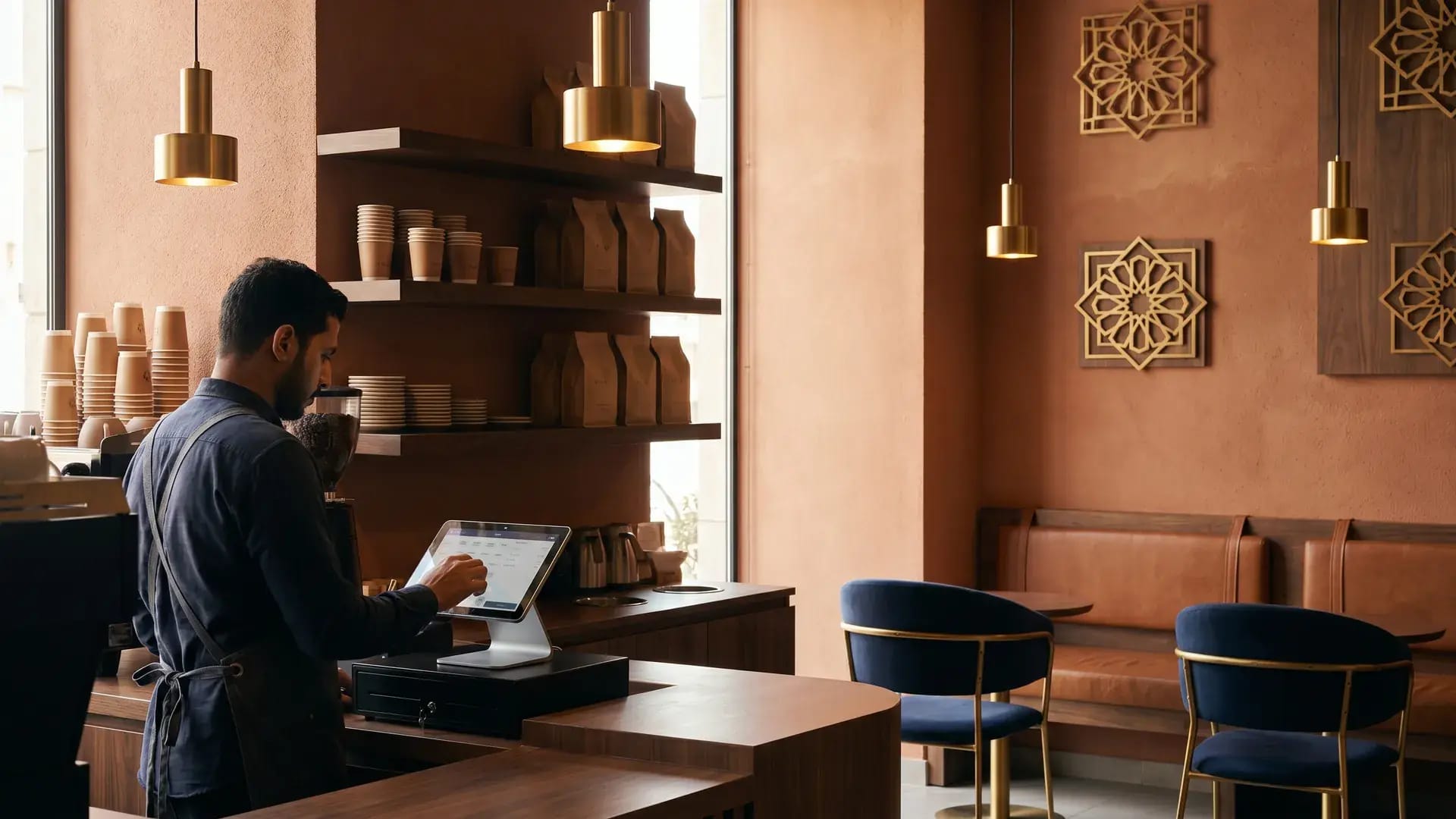
How a 45-Branch Saudi Coffee Chain Cut Waste 11% with Foodics
A composite story grounded in published Foodics customer outcomes and Saudi market data — not a single named customer, but a pattern we see repeatedly across the MENA specialty coffee sector.
This article may contain affiliate links. If you purchase through these links, we may earn a commission at no extra cost to you. This helps support our independent reviews.
The Challenge: Scale Broke the Paper-and-Excel Operating Model
By 2024, Rayyan Coffee had grown from 5 beloved specialty shops in Riyadh to 45 branches across three regions in under four years. The aesthetic was on-point, the green-bean sourcing was genuinely world-class — but the back office was still running on Excel, paper receipts, and five delivery tablets per counter. Something had to give before ZATCA Phase 2 enforcement caught up with them.
- 01
Perishable Waste Was Quietly Bleeding Margin
Baristas counted inventory manually at shift-end, often exhausted, often inconsistent. Milk, syrups, and pastries — the highest-margin, shortest-shelf items — were overstocked across most branches. WRAP research attributes roughly 21% of restaurant food waste to spoilage; Rayyan's internal audits matched that number almost exactly.
- 02
"Tablet Hell" at the Counter
Every branch ran five separate aggregator tablets: Jahez, HungerStation, Talabat, ToYou, and Mrsool. Orders were read off one screen and re-keyed into the POS. Modifiers were missed. Menu changes meant logging into five portals per branch — 225 portal updates for a single seasonal drink swap.
- 03
Price Drift Across 45 Branches
With local cash registers at each branch, price updates were manual per store. A Spanish Latte cost SAR 18 in the Riyadh flagship, SAR 17 in the new Al-Nakheel branch, and SAR 16 in the oldest Jeddah location — none of it intentional, all of it eroding brand trust and making P&L comparisons meaningless.
- 04
Peak-Hour Chaos, Especially in Ramadan
Saudi coffee culture peaks after Maghrib and Isha — narrow windows, explosive volume. Paper tickets got lost between counter and bar. Baristas fell out of sync. Service times during the first half of Ramadan 2024 averaged 9 minutes per order; customer complaints tripled.
- 05
ZATCA Phase 2 Was an Existential Deadline
Rayyan's existing cash registers could not generate cryptographic stamps, UUIDs, or real-time Fatoora XML. Non-compliance fines run up to SAR 50,000 per incident, and their wave enforcement date was 9 months away. Migration was no longer a "someday" project.
The Solution: A 45-Branch Foodics Rollout in Three Waves
After a two-month vendor review that included Foodics, Oracle MICROS, and Toast, leadership chose Foodics for three concrete reasons: a regional HQ in Riyadh, a native ZATCA Phase 2 clearance module, and an iPad-first interface their baristas could genuinely learn in an afternoon.
The deployment followed Foodics' standard two-to-six-week pattern per branch, batched into three regional waves — Riyadh first (22 branches), then Jeddah (14), then Eastern Province (9). The core tech stack was deliberately kept small: Foodics for POS, inventory, and KDS; a single middleware layer for Jahez and HungerStation integration; Zoho Books for daily sales → GL sync; Mudad for payroll; and Tap Payments for card acquisition so mada, Apple Pay, and STC Pay routed cleanly at checkout.
The most important decision wasn't technical — it was naming a "data champion" per region before go-live. Someone senior enough to enforce menu discipline, own the weekly reports, and escalate integration breakdowns before they became fires. Most of the published ROI only shows up when someone owns the dashboard.
The Deployment Timeline
Published Foodics deployments run two to six weeks per branch. With 45 branches and a ZATCA deadline, Rayyan ran three parallel regional waves, overlapping so the full rollout finished in 14 weeks.
Week 1 — Audit & Menu Engineering
Full workflow audit, menu migration into Foodics, 15% VAT configuration, and a hard decision to cut 12 underperforming SKUs before the system ever saw them.
Weeks 2–3 — Hardware & Integrations
iPads, thermal printers, cash drawers, and 5G failover routers installed per branch. App Marketplace integrations enabled: Jahez, HungerStation, Zoho Books, Mudad, Tap Payments, and InvoiceQ for B2B tax invoices.
Weeks 4–5 — Parallel Run & Training
Every branch ran old and new systems simultaneously. Roughly 2,100 barista-training hours across the chain. Shift supervisors signed off on KDS routing and bill-splitting flows before go-live.
Week 6 — Go-Live (Sunday Morning)
Cutover timed for off-peak Sunday mornings, per Foodics best practice. On-site tech support at every branch for the first 72 hours to catch ZATCA sync errors and printer glitches.
Month 3 — First Clean Reconciliation
Daily sales → Zoho Books GL sync produced the first fully reconciled monthly close without a spreadsheet in sight. Finance team reclaimed roughly 4 working days per month.
Month 6 — First Data-Driven Menu Decision
Using Foodics' menu-engineering quadrants (Stars, Plowhorses, Puzzles, Dogs), leadership retired 4 SKUs and repositioned 3 more. Average ticket size rose 6% over the next quarter.

We didn't adopt Foodics to become a tech company. We adopted it to free up the thousand hours a month our baristas were spending on paperwork, and to stop guessing how much milk we'd waste on a Friday night. The espresso still matters more than the app — but the app is why the espresso can stay that good at forty-five locations.
— Composite founder persona, based on patterns from published Foodics customer interviews
Before and After: The Operational Metrics
Every number below sits inside the outcome range that Foodics publicly cites for mid-market multi-branch chains, cross-checked against WRAP restaurant-waste research and ZATCA compliance guidance. Treat them as the honest middle of a realistic range, not ceiling-case marketing.
The Headline Results After 12 Months
These are the numbers Rayyan's CFO would put in a board pack — all within published Foodics outcome ranges, all verifiable against the underlying research.
The Honest Challenges Rayyan Hit Along the Way
No real deployment lands clean. Here are the three friction points Rayyan's team documented — all matching the pattern in Foodics' public Trustpilot reviews and independent engineering blogs.
Arabic Thermal Printing Latency
Thermal printers still use the 1976 ESC/POS protocol, which was never designed for right-to-left contextual Arabic shaping. To render Arabic crisply, Foodics bitmap-prints each receipt — roughly 400ms per ticket versus 180ms for plain Latin text. During Ramadan peaks that adds up. Rayyan piloted three printer models before standardizing on one that handled bitmap rendering fastest.
Hardware Capex Was Bigger Than Budgeted
Per-branch hardware — iPads, certified thermal printers, cash drawers, failover routers — ran SAR 8,100–20,400 depending on branch size. Across 45 branches, the capital layer was meaningfully higher than the "software" framing suggested. Leadership rebudgeted mid-rollout and shifted part of the fit-out pipeline.
Support Escalation Was Sometimes Slow
Foodics' Trustpilot rating sits around 2.3/5 today, driven largely by support-delay complaints. Rayyan experienced one hardware failure in a Jeddah branch where the on-ground replacement took six days. They mitigated by keeping a small swap-pool of spare iPads and printers at the regional office — standard practice any multi-branch operator should copy.
Five Lessons for Any Saudi Coffee Chain Considering Foodics
The shape of Rayyan's rollout maps onto almost every multi-branch F&B digitization story we track. If you're in the 10-plus-branch range and still running paper and Excel, these are the lessons worth front-loading.
Don't Big-Bang a Multi-Branch Cutover
Run a parallel-system window of at least four weeks per wave. Big-bang cutovers break on day one of Ramadan or a Saturday morning rush, and you don't get to reboot a coffee shop.
Name a Data Champion Per Region
Most of the published ROI only materializes when someone owns the reporting. Without a dedicated person enforcing menu discipline and reviewing weekly waste and labor reports, Foodics becomes an expensive cash register.
Pilot Arabic Thermal Printing Before You Buy 45 Printers
Bitmap-rendered Arabic text looks great but adds ~220ms per ticket. Test three printer models under your actual peak volume. The cheapest option is almost never the right one once you account for queue time.
Integrate Accounting and Payroll From Day One
Zoho Books (or Odoo) and Mudad integrations should go live the same week as the POS — not six months later. The productivity gains from the first clean monthly close will pay for half the implementation budget.
Budget for Hardware Capex Separately from SaaS
SAR 8,100–20,400 per branch in certified hardware is not optional. Add a swap-pool of 2–3 spare iPads and 2 spare printers per region for the days a courier takes longer than you'd like.
Could Your Chain Hit the Same Pattern?
If you're running more than ten F&B branches in Saudi Arabia, the pattern Rayyan followed — unify POS, integrate delivery, let a data champion own the dashboards — is the one we see work repeatedly. Whether you choose Foodics or a competitor, the rigor around waste, ZATCA compliance, and multi-branch consistency is what decides the outcome.
See Our Full Foodics Review