Best POS Systems in Saudi Arabia: ZATCA Compliance, Pricing & What Actually Matters
Nadia El-AminApril 6, 202622 min read
NE
Nadia El-AminBusiness Tech Analyst at lkwjd | Published April 6, 2026
This article may contain affiliate links. If you purchase through these links, we may earn a commission at no extra cost to you. This helps support our independent reviews.
Key Takeaways
Saudi Arabia's POS terminal market is worth USD 1.098 billion in 2024 and is projected to hit USD 2.7 billion by 2033 — every business needs a compliant system now, not later.
ZATCA Phase 2 penalties range from SAR 5,000 to SAR 50,000 per violation. Native compliance (Foodics, Marn, Odoo) beats third-party middleware every time.
Foodics is the strongest option for restaurants (SAR 199–625/mo), while Marn POS covers both retail and F&B with competitive lifetime pricing.
Loyverse offers a genuinely free POS but requires third-party middleware for ZATCA Phase 2 — adding hidden cost and compliance risk.
Square and Toast are not viable options in Saudi Arabia. Neither supports native ZATCA compliance, mada payments, or full Arabic RTL interfaces.
Why ZATCA Compliance Is the #1 Factor for Saudi POS Systems
In 2024, electronic retail transactions accounted for 79% of all transactions in Saudi Arabia. Vision 2030 targets a 70% cashless retail economy. If your POS cannot generate ZATCA-compliant e-invoices, you are operating on borrowed time.
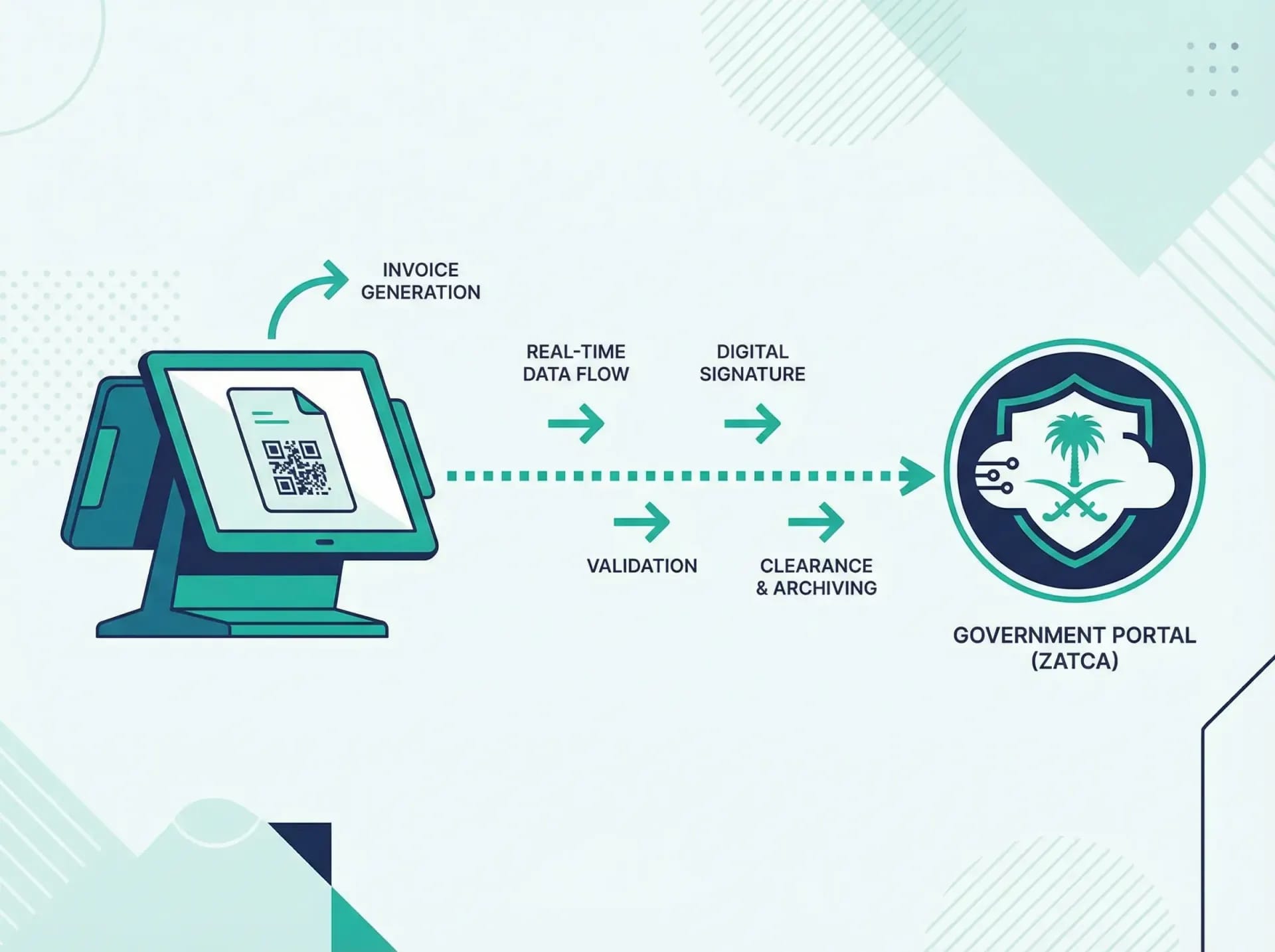
ZATCA's Phase 2 (Integration Phase) is rolling out in waves through 2026. Wave 24 requires all businesses with SAR 375,000+ annual turnover to integrate by June 2026. The requirements are non-negotiable: UBL 2.1 XML format, cryptographic stamps on every invoice, a UUID per transaction, previous invoice hash chaining, and Base64 TLV QR codes. B2B invoices require real-time clearance via the Fatoora portal API. B2C invoices must be reported within 24 hours.
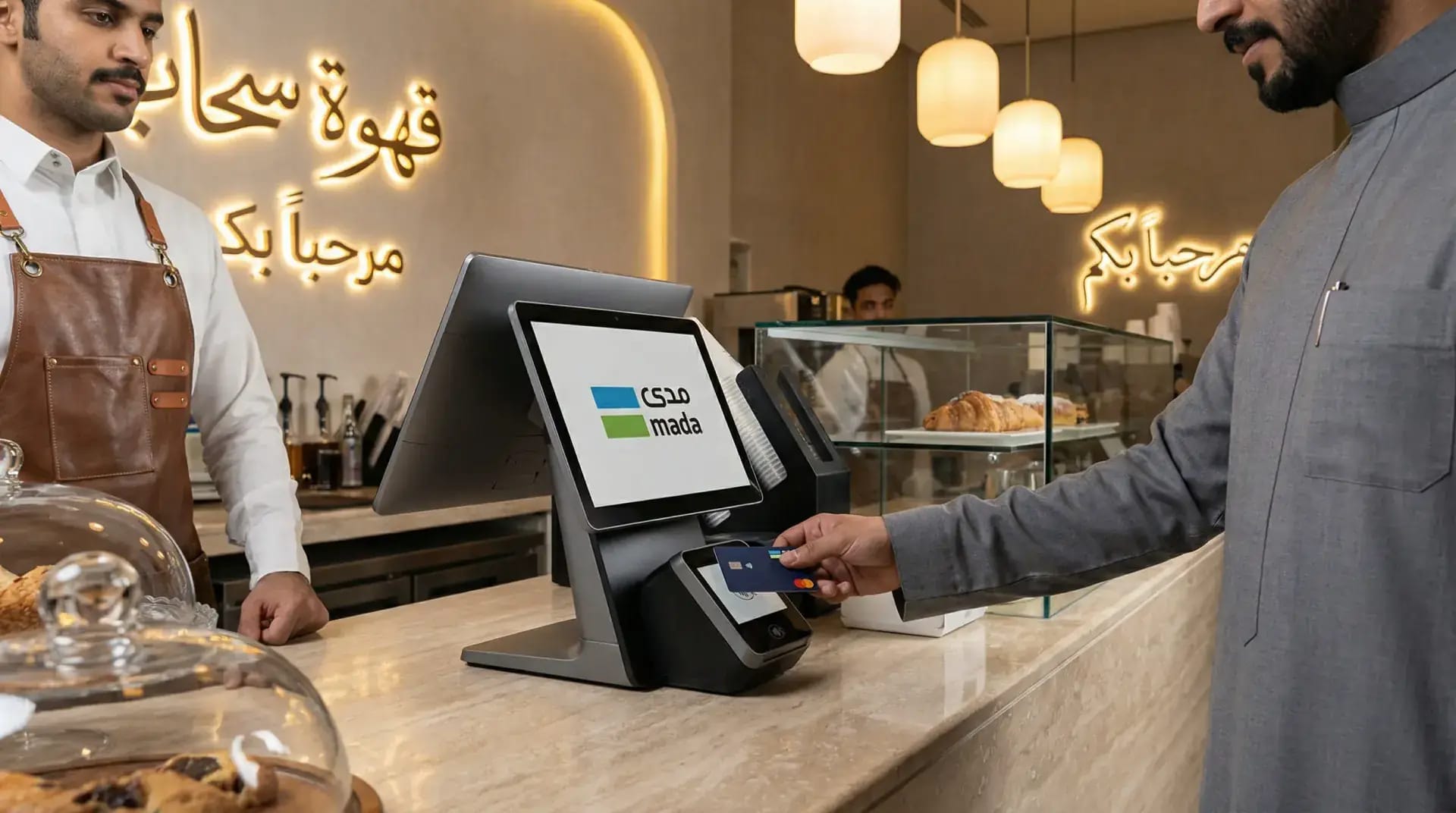
The mada network now has 2.1 million active terminals across the Kingdom, and contactless transactions account for 34% of all POS spending. Any POS system that cannot natively process mada, STC Pay, and Apple Pay is leaving money on the counter — literally. Your payment terminal is no longer optional infrastructure; it is the backbone of your compliance stack.
What does this mean for choosing a POS? It means compliance is not a feature — it is a prerequisite. The systems in this guide are ranked first by their ZATCA Phase 2 readiness, then by payment integration, Arabic support, offline capability, and total cost of ownership.
Quick Comparison: 9 POS Systems for Saudi Arabia
Before we dive into individual reviews, here is how all nine platforms stack up across the factors that matter most for Saudi businesses.
Platform
Best For
Starting Price
ZATCA Phase 2
Arabic / RTL
Rating
Foodics
Restaurants & F&B
SAR 199/mo
Native
Full RTL
4.7
Marn POS
Retail + Restaurant
Tiered / Lifetime
Native
Full RTL
4.5
Odoo POS
ERP + Retail + F&B
~$20/mo + modules
Native (l10n_sa)
Full RTL
4.3
Loyverse
Budget / Micro-business
Free core
3rd-party middleware
Partial
3.9
POSRocket
Small restaurants
~SAR 154/mo
Compliant
Native Arabic
4.0
iiko
AI-driven restaurants
Custom pricing
Via InvoiceQ SDK
Supported
4.1
Lightspeed
Enterprise retail
SAR 300–6,000+/mo
Via Hyperspace
Supported
3.8
Square
Not recommended
N/A in KSA
None
Limited
2.0
Toast
Not recommended
US pricing only
None
Limited
2.0
ZATCA Phase 2: What Your POS Must Do
Before evaluating individual platforms, you need to understand exactly what ZATCA Phase 2 demands from your point-of-sale system. This is not optional — it is the law.
ZATCA Phase 2 requires real-time integration between your POS and the Fatoora portal for B2B clearance.
Every transaction must generate a UBL 2.1 XML invoice with a cryptographic stamp, a universally unique identifier (UUID), and a hash linking it to the previous invoice. B2B invoices are sent to the Fatoora portal API for real-time clearance before you can share them with customers. B2C simplified invoices must be reported to ZATCA within 24 hours. Both types require a Base64 TLV-encoded QR code printed on the receipt.
Offline scenarios are not an excuse. ZATCA expects your system to cache signed XML invoices locally and sync them to the portal once connectivity returns. POS systems without robust offline architecture put you at risk of non-compliance every time your internet drops — and in Saudi retail environments, that happens more often than vendors admit.
ZATCA penalties range from SAR 5,000 to SAR 50,000 per violation. A single busy weekend with a non-compliant POS could cost more than a full year of software subscription fees.
1. Foodics — Best for Restaurants & F&B Operations
Saudi-founded in 2014, Foodics has grown into the largest cloud restaurant platform in the Middle East with over 50,000 F&B businesses across 35+ countries.
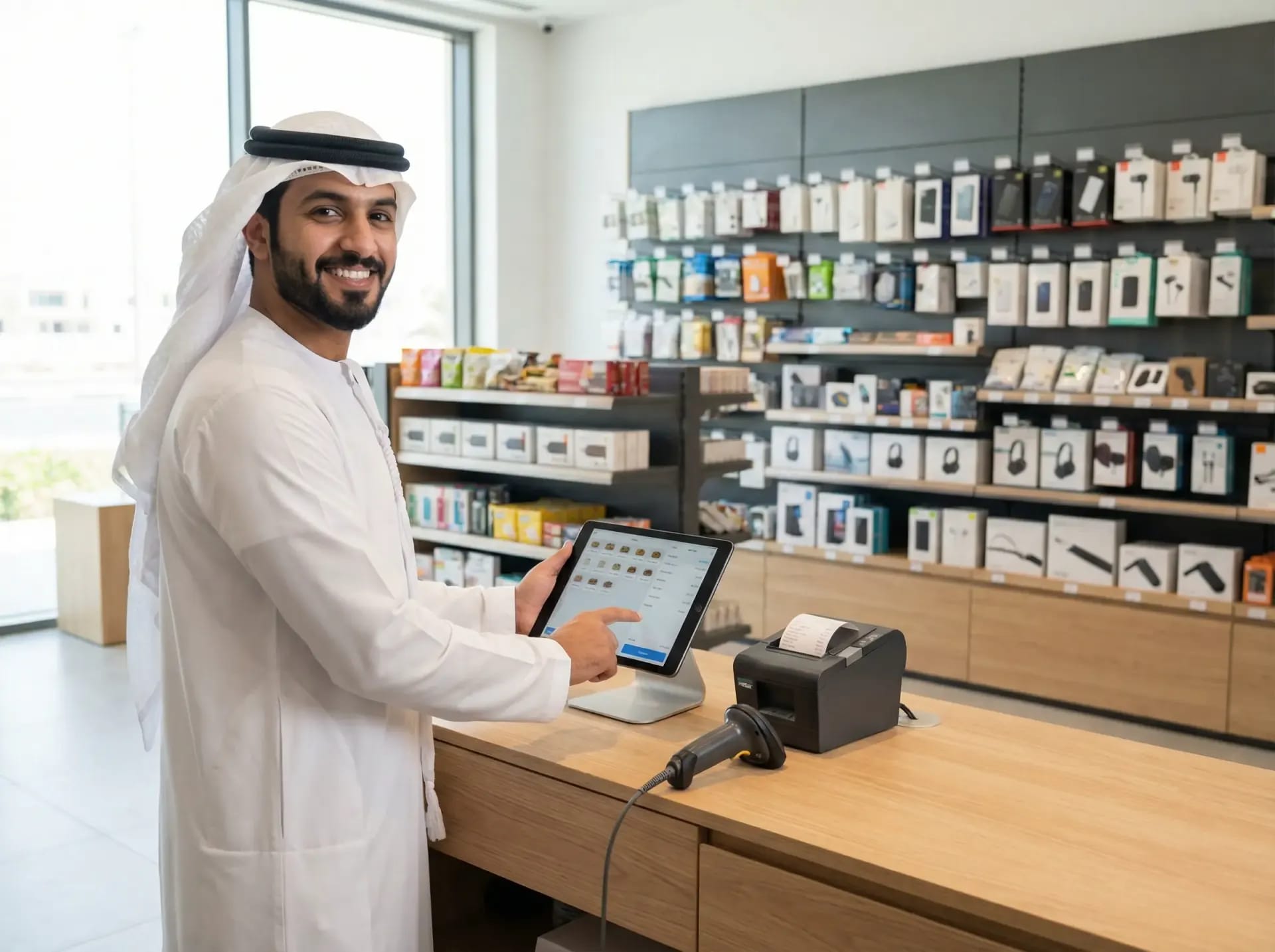
Foodics delivers a polished iPad-based POS with native ZATCA Phase 2 compliance and Arabic RTL support.
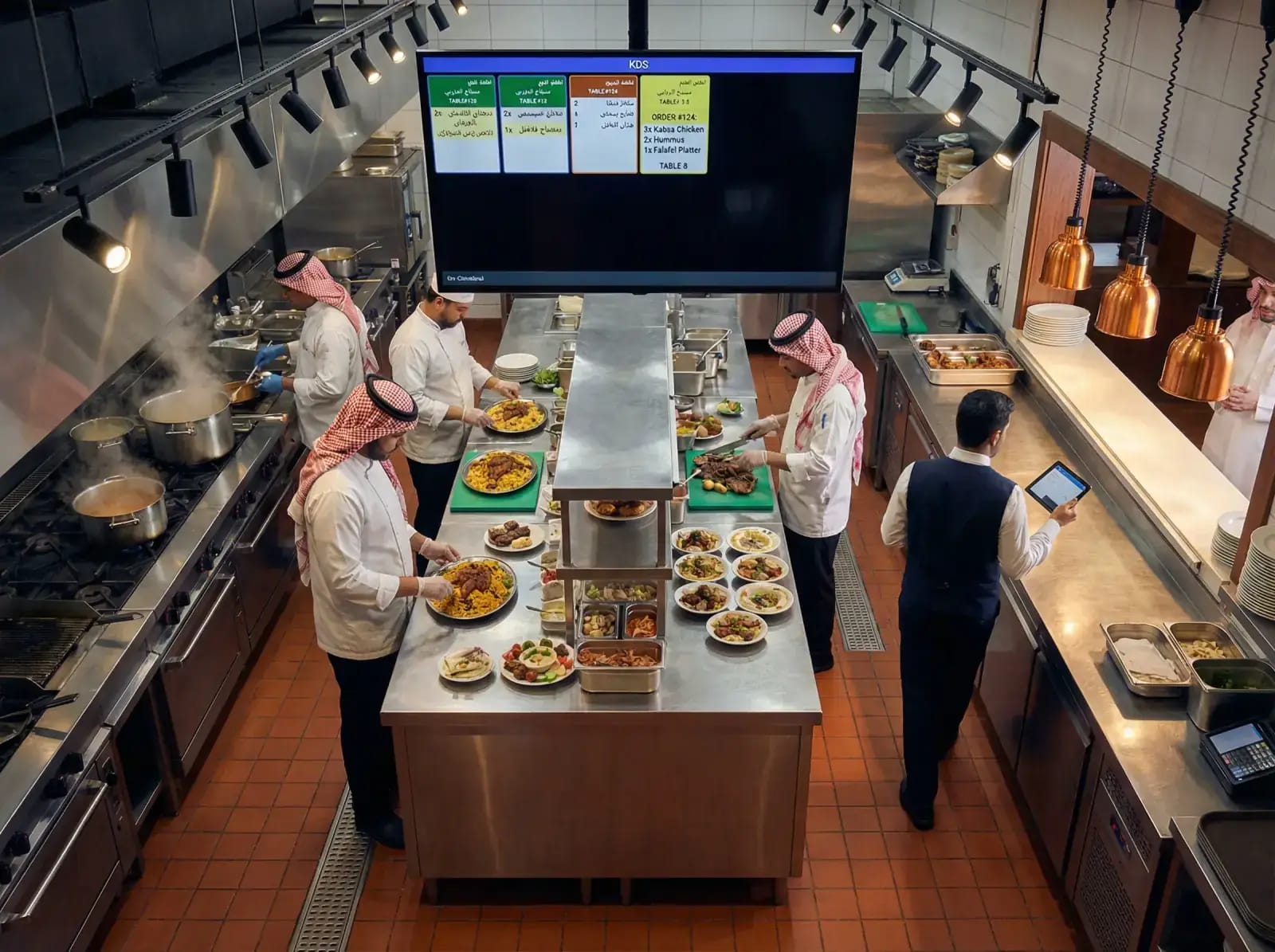
Foodics is purpose-built for food and beverage. The platform covers POS, inventory with recipe-level depletion, kitchen display, CRM, delivery aggregation (HungerStation, Jahez, Marsool), HR, payroll, and embedded lending via Foodics Capital. Payment processing runs through Foodics Pay with native mada, STC Pay, and Apple Pay integration — no third-party terminal needed.
ZATCA Phase 2 compliance is fully built in. Every invoice is generated in UBL 2.1 XML with cryptographic stamps, UUID chaining, and QR codes. The system handles B2B clearance and B2C reporting automatically. Offline mode caches transactions and syncs when connectivity returns. The entire interface runs natively in Arabic with full RTL support.
Foodics pricing (billed annually):
Starter
Starter: SAR 199/mo — single outlet, basic POS, inventory
Basic
Basic: SAR 399/mo — multi-branch, KDS, delivery integration
Advance
Advanced: SAR 625/mo — full suite including HR, payroll, Foodics Capital, advanced analytics
Pros
Most complete restaurant POS ecosystem in the MENA region — POS, inventory, KDS, CRM, delivery, payroll all in one
Native ZATCA Phase 2 compliance with zero third-party dependencies
Foodics Pay eliminates the need for separate payment terminal contracts
Proven scale: 50,000+ establishments, $6 billion GMV in H1 2025
Cons
iPad-only for the cashier app — no Android or Windows support, requiring Apple hardware investment from SAR 3,500+
Restaurant-focused only — not suitable for general retail, fashion, or grocery stores
2. Marn POS — Best for Retail + Restaurant Hybrid
Marn is a Saudi-born POS platform that covers both retail and restaurant operations — a rare combination in the local market. It also offers self-ordering kiosks through Marn Go.
Marn POS is designed specifically for the Saudi retail and service market
Marn POS handles everything from quick-service restaurants to retail shops under a single platform. Native ZATCA Phase 2 compliance is built in, and payment processing runs through Marn Payment with mada, STC Pay, and Apple Pay. The self-ordering kiosk feature (Marn Go) is a standout — letting customers place orders independently, reducing counter queues and labor costs.
The pricing model is unique in the Saudi market: Marn offers both monthly subscription tiers and a lifetime purchase option. The Enterprise tier includes offline mode, which caches transactions locally and syncs automatically. Full Arabic RTL support runs across every screen and report.
Pros
Covers both retail and restaurant use cases under one platform — no need for separate systems
Native ZATCA Phase 2 with automatic B2B clearance and B2C reporting
Marn Go self-ordering kiosks reduce labor costs and improve throughput
Lifetime pricing option eliminates ongoing subscription costs for budget-conscious businesses
Cons
Smaller ecosystem than Foodics — fewer third-party integrations and marketplace add-ons
Offline mode is only available on the Enterprise tier, leaving lower tiers vulnerable during connectivity drops
3. Odoo POS — Best for ERP-Integrated Operations
Odoo POS is the point-of-sale module within Odoo's comprehensive open-source ERP suite. For businesses that need POS, inventory, accounting, HR, and e-commerce in a single platform, it is hard to beat on value.
Odoo's Saudi localization (l10n_sa_edi_pos) provides native ZATCA Phase 2 compliance. Invoices are generated in UBL 2.1 XML with cryptographic stamps, and the system handles both B2B clearance and B2C reporting through the Fatoora portal. The POS module integrates directly with Odoo's inventory, accounting, purchase, and manufacturing modules — so a sale on the shop floor automatically updates stock levels, triggers reorder rules, and posts to your general ledger.
The tradeoff is complexity. Odoo is an ERP first and a POS second. Setup requires configuring the Saudi localization, registering your Cryptographic Stamp Identifier (CSR) with ZATCA, and testing in the sandbox environment before going live. ZATCA-specific modules from the Odoo App Store range from SAR 590 to SAR 3,650. The learning curve is steep, but the payoff is a fully integrated business system.
Pros
Full ERP integration — POS, inventory, accounting, HR, manufacturing, and e-commerce in one system
Native ZATCA Phase 2 via official Saudi localization module (l10n_sa_edi_pos)
Advanced offline mode with asynchronous sync — transactions are cached and posted automatically
Open-source foundation means zero vendor lock-in and extensive customization options
Cons
Steep learning curve — initial setup requires technical confidence for CSR registration and ZATCA sandbox testing
ZATCA modules add SAR 590–3,650 on top of the base subscription, making total cost harder to predict
4. Loyverse — Best Free POS for Micro-Businesses
Loyverse offers a genuinely free core POS application. For micro-businesses and startups with tight budgets, it is the most accessible entry point — but ZATCA compliance requires extra work.
The core Loyverse POS is free: sales processing, basic inventory, customer management, and analytics cost nothing. Paid add-ons for employee management (SAR 93/mo), advanced inventory (SAR 93/mo), and integrations (SAR 18/mo) are available but optional. The app runs on iPads and Android tablets, giving you hardware flexibility.
The catch is ZATCA Phase 2. Loyverse does not natively generate ZATCA-compliant e-invoices. You need third-party middleware — Abzer, Dwaer, or Tax2Gov — to bridge the gap. This adds cost (typically SAR 50–150/mo), introduces a compliance dependency on an external vendor, and complicates troubleshooting when something breaks. Payment processing requires standalone mada terminals; there is no integrated payment solution like Foodics Pay or Marn Payment.
Pros
Genuinely free core POS — no subscription fees for basic sales, inventory, and analytics
Cross-platform: runs on both iPad and Android tablets, avoiding Apple hardware lock-in
Simple, intuitive interface that requires minimal training for staff
Cons
No native ZATCA Phase 2 compliance — requires third-party middleware at additional cost and compliance risk
No integrated payment processing — requires separate mada terminal contracts and manual reconciliation
The following platforms serve specific niches or are frequently asked about by Saudi business owners. Here is a quick assessment of each.
POSRocket
Acquired by Foodics in 2022, POSRocket is a solid budget option for small restaurants. It is fully ZATCA compliant with native Arabic support and BYOD hardware flexibility. Reporting is basic compared to Foodics, but for single-location restaurants that need compliance without complexity, it works.
Good budget restaurant POS. Expect eventual migration to the Foodics ecosystem.
iiko
iiko differentiates with AI-driven demand forecasting and automated purchasing. ZATCA compliance runs through the InvoiceQ SDK integration. The platform handles Arabic and offers advanced offline sync. Custom pricing means you need to request a quote, which can slow down the evaluation process.
Best for data-driven restaurant chains that want AI forecasting. Overkill for single outlets.
Lightspeed
Lightspeed offers enterprise-grade inventory management and multi-location retail capabilities. ZATCA compliance requires the Hyperspace third-party integration, adding cost and complexity. Arabic support is available but not as polished as Saudi-native platforms. The total cost of ownership is the highest on this list.
Enterprise-grade retail POS with premium pricing. ZATCA via third-party adds friction.
Square
Square is not officially available in Saudi Arabia for payment processing. There is no native ZATCA compliance, no mada integration, and limited Arabic support. Some businesses try to use Square for inventory management only, but this creates a fragmented workflow with no compliance benefits.
Not recommended for Saudi businesses. No local payment processing, no ZATCA support.
Toast
Toast is a US-focused restaurant POS with no meaningful Saudi Arabia presence. There is no native ZATCA compliance, no mada integration, and limited Arabic language support. The hardware is designed for the American market and the pricing structure does not account for Saudi tax or payment requirements.
Not viable for Saudi Arabia. US-only platform with no localization roadmap.
How to Choose the Right POS for Your Saudi Business
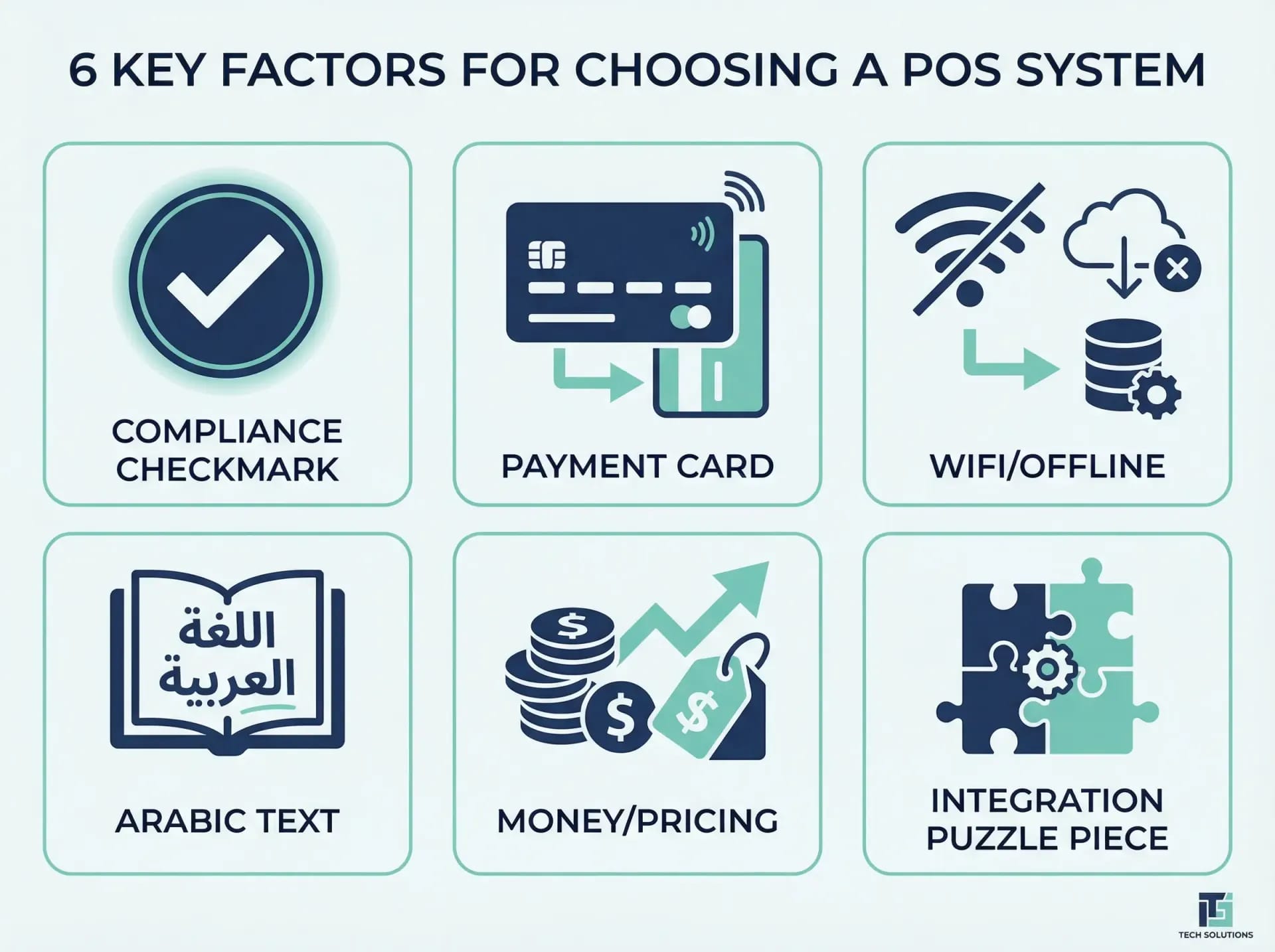
With nine platforms evaluated, here are the six factors that should drive your decision — ranked by importance for the Saudi market.
The six factors that matter most when selecting a POS system for the Saudi market.
01
1. ZATCA Phase 2 Compliance
Non-negotiable. Choose native compliance (Foodics, Marn, Odoo) over third-party middleware. Native means the vendor owns the integration, updates it when ZATCA changes rules, and handles errors automatically. Middleware means you are dependent on two vendors instead of one.
02
2. mada / STC Pay / Apple Pay Integration
With 2.1 million active mada terminals and contactless transactions hitting 34% of POS spending, integrated payment processing eliminates reconciliation headaches. Foodics Pay and Marn Payment both offer native mada support. Standalone terminals work but add manual steps.
03
3. Offline Architecture
Internet connectivity in Saudi retail environments is not 100% reliable. Your POS must cache signed XML invoices locally and sync them when connectivity returns. Foodics, Marn (Enterprise), and Odoo handle this natively. Loyverse offers basic offline but without ZATCA-compliant caching.
04
4. Arabic / RTL Support
Full Arabic RTL support means every screen, receipt, report, and customer-facing display renders correctly in Arabic. Saudi-born platforms (Foodics, Marn) do this natively. International platforms (Lightspeed, Square) often treat Arabic as a secondary language with visual inconsistencies.
05
5. Hardware Flexibility
Proprietary hardware (Foodics at SAR 3,500+) delivers a polished experience but locks you in. BYOD platforms (POSRocket, Loyverse) let you use existing tablets but may sacrifice peripheral integration. Evaluate whether you already own compatible hardware before committing.
06
6. ERP / E-Commerce Extensibility
If you need inventory, accounting, HR, and e-commerce under one roof, Odoo is unmatched. If you only need POS and payment processing, a focused platform like Foodics or Marn will be simpler to manage and faster to deploy.
Our Verdict
Final Verdict: lkwjd Scores
After testing all nine platforms against ZATCA compliance, payment integration, Arabic support, offline capability, pricing, and ecosystem breadth, here are our final scores and recommendations.
Best for Restaurant
Foodics4.7/ 5
the most complete F&B platform in the region with native ZATCA, Foodics Pay, and proven scale across 50,000+ establishments.
Best for Retail
Marn POS4.5/ 5
the only Saudi platform covering both retail and restaurant with native compliance, Marn Go kiosks, and lifetime pricing options.
Best for Budget
Loyverse3.9/ 5
free core POS for micro-businesses, but factor in SAR 50–150/mo for ZATCA middleware and separate mada terminal costs.
Best for Enterprise
Odoo POS4.3/ 5
full ERP integration with native ZATCA localization, ideal for businesses that need POS + inventory + accounting + HR in one system.
Frequently Asked Questions
01What is ZATCA Phase 2 and does my POS need to support it?
ZATCA Phase 2 (Integration Phase) requires all Saudi businesses above SAR 375,000 annual turnover to generate e-invoices in UBL 2.1 XML format with cryptographic stamps, UUID chaining, and QR codes. B2B invoices must be cleared in real-time through the Fatoora portal. B2C invoices must be reported within 24 hours. Penalties range from SAR 5,000 to SAR 50,000 per violation. Yes, your POS must support it — either natively (Foodics, Marn, Odoo) or through third-party middleware (Loyverse with Abzer/Dwaer).
02Can I use Square or Toast POS in Saudi Arabia?
Square is not officially available in Saudi Arabia for payment processing. Toast is a US-focused platform with no Saudi localization. Neither supports native ZATCA compliance, mada payment integration, or full Arabic RTL interfaces. We do not recommend either platform for Saudi businesses. Foodics, Marn, and Odoo are significantly better options with native Saudi market support.
03What is the cheapest ZATCA-compliant POS system?
Loyverse offers a free core POS, but you need third-party middleware (SAR 50–150/mo) for ZATCA Phase 2 compliance plus separate mada terminal fees. The cheapest natively compliant option is Foodics Starter at SAR 199/mo (billed annually), which includes built-in ZATCA compliance and Foodics Pay integration. Odoo base pricing starts around $20/mo but ZATCA modules add SAR 590–3,650.
04Does my POS system work offline during internet outages?
It depends on the platform. Foodics and Odoo both cache transactions locally during outages and sync automatically when connectivity returns, including signed ZATCA-compliant XML invoices. Marn offers offline mode on the Enterprise tier only. Loyverse has basic offline but without ZATCA-compliant invoice caching. For Saudi retail environments where internet stability varies, offline capability is critical for compliance.
05Should I choose a Saudi POS or an international one?
For most Saudi businesses, a locally-built platform (Foodics, Marn) offers significant advantages: native ZATCA compliance, mada/STC Pay integration, full Arabic RTL, local support in Arabic, and pricing in SAR. International platforms (Lightspeed, Odoo) can work but typically require additional configuration, third-party integrations for compliance, and may have English-first support. Choose international only if you need specific capabilities — like Odoo's full ERP suite — that local platforms do not offer.
Share this article:
Never Pick the
Wrong Tool Again.
Get weekly expert recommendations, honest comparisons, and exclusive guides — tailored for the Middle East market.