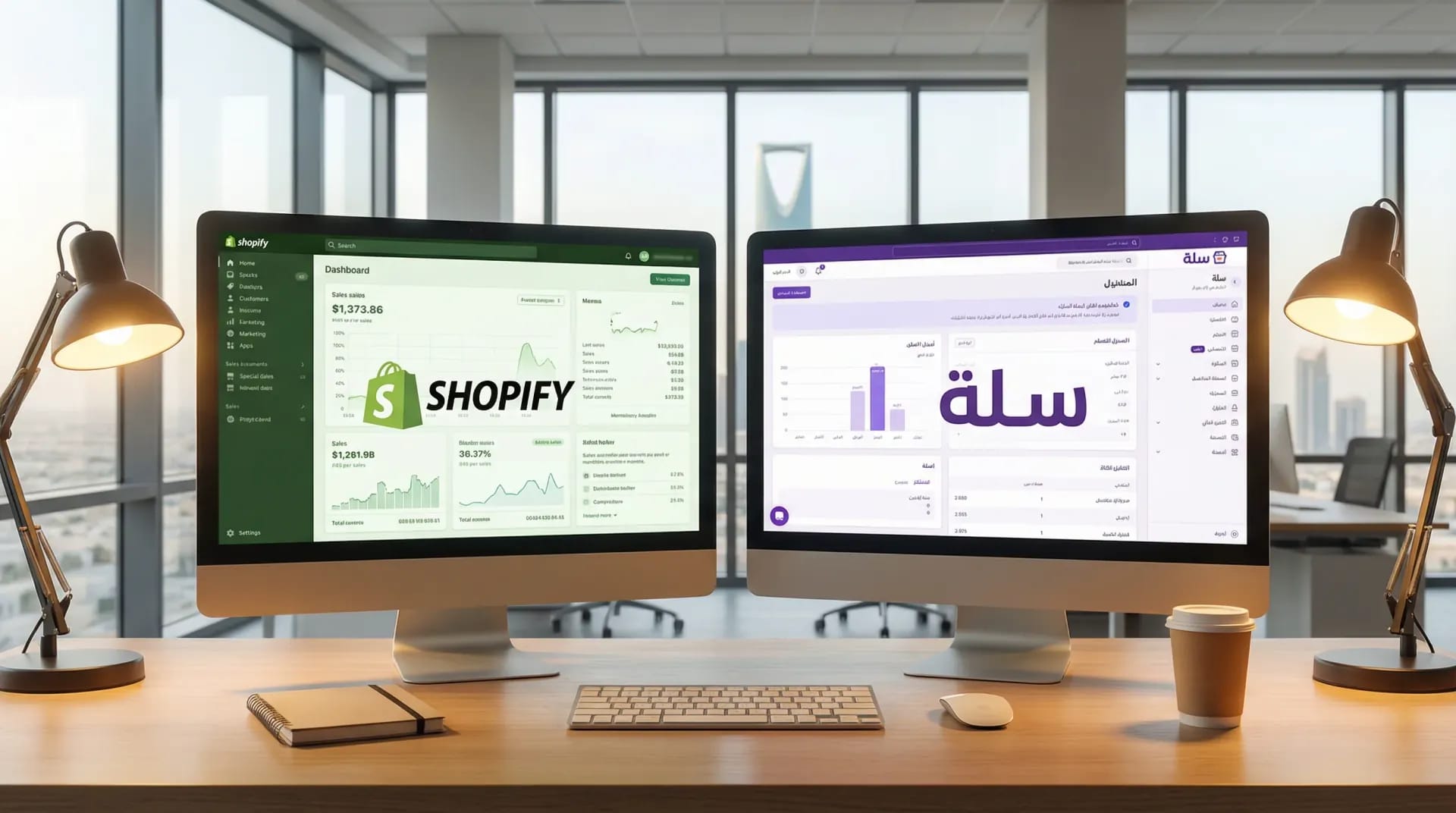
Shopify vs Salla: Which Is Better for Saudi Sellers?
This article may contain affiliate links. If you purchase through these links, we may earn a commission at no extra cost to you. This helps support our independent reviews.
Key Takeaways
- Salla is the better choice for Arabic-first sellers who want a fully localized experience with built-in ZATCA compliance, native Saudi payment gateways, and pricing in SAR.
- Shopify is the stronger platform for sellers who plan to scale internationally, need a massive app ecosystem, or want advanced customization through Liquid templating.
- Salla starts at 99 SAR/month (~$26) with a free plan available, while Shopify Basic costs $27/month -- making them comparable at entry level.
- Both platforms support Tap Payments, Tabby, Apple Pay, Aramex, and SMSA, but Salla integrates them natively while Shopify often requires third-party apps.
- For ZATCA Phase 2 e-invoicing compliance, Salla has it built in from day one. Shopify requires a third-party ZATCA app that costs an additional SAR 99-299/month.
Why This Comparison Matters for Saudi Sellers
Saudi Arabia's e-commerce market hit $13.7 billion in 2025, growing 20% year-over-year. Whether you choose Shopify or Salla will shape your costs, compliance, and growth trajectory for years to come.
If you are launching an online store in Saudi Arabia in 2026, you have two serious contenders: Shopify, the global e-commerce giant powering 4.8 million stores worldwide, and Salla, the Saudi-born platform that has rapidly grown to over 55,000 active stores across the MENA region.
This is not a simple question of 'global vs local.' Each platform makes genuine trade-offs. Shopify offers unmatched scale, a 13,000+ app ecosystem, and battle-tested infrastructure. Salla offers native Arabic RTL support, built-in ZATCA compliance, and deep integration with Saudi payment and logistics providers.
We tested both platforms side by side over three weeks -- setting up stores, adding products in Arabic, configuring Saudi payment gateways, testing shipping integrations, and evaluating ZATCA compliance workflows. This article covers everything we found.
Platform Overview: Shopify vs Salla
Before diving into feature-by-feature comparisons, it helps to understand where each platform comes from and what it was designed to do.

What Is Shopify?
Founded in 2006 in Ottawa, Canada, Shopify is the world's largest dedicated e-commerce platform. It powers over 4.8 million online stores across 175 countries, processes over $235 billion in annual GMV, and offers everything from basic storefront hosting to enterprise-grade solutions through Shopify Plus.
For Saudi sellers, Shopify provides a solid foundation but requires additional configuration. Arabic RTL support is available through select themes, payment gateways like Tap and HyperPay must be installed as third-party apps, and ZATCA compliance requires a dedicated plugin.
What Is Salla?
Founded in 2016 in Riyadh, Salla (salla.com) is a Saudi-native e-commerce platform built from the ground up for the Arabic-speaking market. It now hosts over 55,000 active online stores, processes SAR 8+ billion in annual transactions, and is the fastest-growing e-commerce platform in the GCC region.
Salla's core advantage is localization. The entire platform -- dashboard, documentation, customer support, themes, checkout -- is Arabic-first. ZATCA Phase 2 e-invoicing is built in, Saudi payment gateways are native integrations (not plugins), and shipping with Aramex, SMSA, and J&T is preconfigured.
| Feature | Shopify | Salla |
|---|---|---|
| Arabic RTL Support | Via select themes + customization | Native, full platform |
| ZATCA Compliance | Third-party app required | Built-in |
| Payment Gateways | 100+ (Tap, HyperPay via apps) | 20+ (Tap, Tabby, STC Pay native) |
| App / Plugin Ecosystem | 13,000+ apps | 200+ apps |
| Delivery Integration | Via apps (Aramex, SMSA) | Native (Aramex, SMSA, J&T, SPL) |
| Multi-language | Yes (20+ languages) | Arabic + English |
| Customer Support (Arabic) | Limited (English-first) | Full Arabic support 24/7 |
Ease of Use: Setup, Dashboard & Arabic Support
Getting from sign-up to a functioning store is where the two platforms diverge most dramatically. The setup experience reveals the fundamental difference in their target audiences.
Shopify: Polished but English-First
Shopify's onboarding is world-class -- guided setup wizards, pre-populated demo data, and helpful tooltips at every step. However, the experience is designed for English-speaking merchants first. To run a Saudi store, you will need to:
- Switch your theme to an RTL-compatible option (not all free themes support this)
- Install a language translation app for Arabic storefront content
- Configure tax settings manually for Saudi 15% VAT
Salla: Arabic-Native from Login
Salla's dashboard loads in Arabic by default. Every menu item, settings page, and help article is written in Arabic first. The setup wizard asks for your Saudi Commercial Registration (CR) number upfront and pre-configures VAT settings automatically.
- Dashboard, checkout, and customer emails are all Arabic-first by default
- CR number verification and Maroof integration are part of onboarding
- 15% VAT and ZATCA e-invoicing are pre-configured -- no manual setup needed
If your primary audience is Saudi shoppers and your team operates in Arabic, Salla's setup experience saves you 2-3 hours of configuration that Shopify requires through third-party apps and manual settings.
Design & Themes: Template Quality and Customization
Both platforms offer theme marketplaces, but they cater to very different design needs and skill levels.

Shopify: 200+ Themes, Deep Customization
Shopify offers over 200 professionally designed themes (13 free, the rest $180-$400). The Liquid templating engine gives developers full control over HTML, CSS, and JavaScript. For Saudi stores, the Dawn, Sense, and Taste themes handle RTL well, but you may still need a developer to fine-tune Arabic typography and layout details.
Salla: 80+ Arabic-First Themes
Salla's theme marketplace offers 80+ templates, all designed for Arabic RTL layouts from the start. Free themes are available, and premium themes range from SAR 200-800. While customization depth is more limited than Shopify's Liquid engine, the drag-and-drop editor handles most layout changes without code. For sellers who want a beautiful Arabic store without hiring a developer, Salla themes are ready out of the box.
The trade-off is clear: Shopify wins on theme variety and deep customization for developers. Salla wins on Arabic-ready design that works without code changes.
Payment & Shipping: Local Integration
Payment gateways and shipping carriers are where the 'local vs global' distinction matters most. Both platforms support the key Saudi providers, but the integration depth differs significantly.
Payment Gateways
| Gateway | Shopify | Salla |
|---|---|---|
| Tap Payments | Via app (Tap official) | Native integration |
| Tabby (BNPL) | Via app | Native integration |
| Tamara (BNPL) | Via app | Native integration |
| STC Pay | Not available | Native integration |
| Apple Pay | Via Shopify Payments | Via Tap integration |
| Cash on Delivery | Manual setup | Built-in with verification |
Shipping Carriers
| Carrier | Shopify | Salla |
|---|---|---|
| Aramex | Via app (Aramex Shipping) | Built-in integration |
| SMSA Express | Via app (SMSA Shipping) | Built-in integration |
| DHL Express | Built-in (Shopify Shipping) | Built-in integration |
| J&T Express | Via third-party app | Built-in integration |
| Red Box (SPL) | Not available | Built-in integration |
Salla has a clear edge in local payment and shipping integration. STC Pay, J&T Express, and RedBox lockers are Saudi-specific services that Salla supports natively but Shopify does not offer at all. For COD orders -- still 35-40% of Saudi e-commerce transactions -- Salla's built-in verification system reduces fraud rates significantly.
Try Shopify for Your Saudi Store
3-day free trial, then $1/month for 3 months. Set up payments, shipping, and Arabic support.
Start Free TrialPricing Comparison: Side-by-Side Plans
Both platforms offer tiered pricing, but the value proposition differs at each level. Here is how they compare head-to-head.
| Tier | Shopify Plan | Shopify Price | Salla Plan | Salla Price |
|---|---|---|---|---|
| Entry | Basic | $27/mo | Basic | 99 SAR/mo (~$26) |
| Mid-Range | Shopify | $72/mo | Plus | 199 SAR/mo (~$53) |
| Advanced | Advanced | $399/mo | Pro | 399 SAR/mo (~$106) |
At the entry level, both platforms cost roughly the same. But the gap widens dramatically at higher tiers. Shopify Advanced at $399/month is nearly 4x the cost of Salla Pro at 399 SAR/month (~$106). However, Shopify Advanced includes features like third-party calculated shipping rates, custom reports, and up to 15 staff accounts that Salla Pro does not match.
Salla also offers a free plan (Salla Free) with limited features -- up to 50 products and basic analytics. Shopify has no free plan but offers a 3-day trial followed by $1/month for 3 months.
Hidden cost alert: Shopify charges a 2% transaction fee on non-Shopify Payments orders (reduced to 1% on the Shopify plan, 0.6% on Advanced). Since Shopify Payments is not available in Saudi Arabia, you will always pay this fee on top of your payment gateway charges. Salla does not charge any transaction fees on any plan.
ZATCA & VAT Compliance
Saudi Arabia's Zakat, Tax and Customs Authority (ZATCA) requires all businesses to issue Phase 2 e-invoices with QR codes and submit them electronically. This is not optional -- non-compliance results in fines starting at SAR 5,000 per violation.
Shopify: Requires Third-Party App
Shopify does not have built-in ZATCA compliance. You need to install a ZATCA e-invoicing app from the Shopify App Store. The most popular options are:
- ZATCA E-Invoice by Invoicemaker (SAR 149/month) -- generates QR-coded invoices and submits to ZATCA API
- Fatora ZATCA Integration (SAR 99/month) -- basic compliance for smaller stores
- Custom API integration through a developer (SAR 5,000-15,000 one-time setup)
Salla: Built-In from Day One
Salla has full ZATCA Phase 2 compliance built into every plan, including the free tier. The system automatically:
- Generates ZATCA-compliant e-invoices with QR codes for every transaction
- Submits invoices electronically to the ZATCA portal in real time
- Handles credit notes, debit notes, and invoice corrections per ZATCA specifications
For Saudi-registered businesses, ZATCA compliance is not negotiable. Salla's built-in approach saves SAR 1,188-3,588 per year compared to Shopify's app-based solution. If ZATCA compliance is your top priority, Salla is the clear winner.
Pros & Cons: The Honest Side-by-Side
Shopify
✅ Pros
- Massive app ecosystem (13,000+ apps) for virtually any feature you need
- Best-in-class infrastructure -- 99.99% uptime, global CDN, unlimited bandwidth
- Deep customization through Liquid templating and headless commerce (Hydrogen)
- Proven ability to scale from startup to enterprise (Shopify Plus)
- Strong international selling features -- multi-currency, multi-language, global shipping
❌ Cons
- Arabic RTL support requires theme selection and manual configuration
- ZATCA compliance requires a paid third-party app (SAR 99-149/month extra)
- 2% transaction fee on all Saudi orders since Shopify Payments is not available in KSA
- Customer support is English-first with limited Arabic availability
Salla
✅ Pros
- Fully Arabic-native platform -- dashboard, themes, checkout, and support all in Arabic
- Built-in ZATCA Phase 2 e-invoicing on all plans including the free tier
- No transaction fees on any plan -- your payment gateway fees are your only cost
- Native integration with Saudi payment gateways (STC Pay, Tabby, Tamara) and carriers (SMSA, J&T, RedBox)
- Free plan available with up to 50 products -- lowest barrier to entry
❌ Cons
- Limited app ecosystem (200+ apps vs Shopify's 13,000+)
- Theme customization is more restricted -- no equivalent to Shopify's Liquid engine
- International selling features are basic -- primarily designed for Saudi/GCC markets
- Fewer third-party integrations for marketing, analytics, and CRM tools
Both platforms have genuine strengths that serve different seller profiles. The 'right' choice depends entirely on your specific business needs, target market, and growth plans.
 Our Verdict
Verdict: Which Platform Should You Choose?

Choose Shopify If...
Shopify is the better choice for sellers who plan to grow beyond the Saudi market or need advanced customization capabilities.
- You plan to sell internationally and need multi-currency, multi-language support
- You need advanced integrations (ERP, CRM, marketing automation) from a 13,000+ app ecosystem
- You have a developer or want deep theme customization through Liquid/Hydrogen
Choose Salla If...
Salla is the better choice for Saudi-focused sellers who want a localized, low-friction experience with no hidden costs.
- Your primary market is Saudi Arabia and your team operates in Arabic
- ZATCA compliance, STC Pay, and local shipping carriers are must-haves from day one
- You want the lowest total cost of ownership with no transaction fees and SAR pricing
For most Saudi-focused sellers launching their first online store, Salla offers the faster path to revenue. The Arabic-native experience, built-in ZATCA compliance, native payment gateways, and zero transaction fees create a compelling package that Shopify cannot match without significant additional configuration and cost.
For sellers with international ambitions, a development team, or complex integration requirements, Shopify remains the more powerful and flexible platform. Its ecosystem depth and proven scalability are unmatched in the e-commerce space.
Ready to Launch Your Saudi Store?
Shopify offers a 3-day free trial. Salla has a free plan to get started. Try both and decide.
Start Free Shopify TrialFrequently Asked Questions
01Can I use both Shopify and Salla at the same time?
Technically yes, but it is not recommended. Managing inventory, orders, and customer data across two platforms creates operational complexity. Most sellers pick one platform and commit. If you are unsure, start with Salla's free plan to test the local experience, then compare with Shopify's $1/month trial period.
02Is Salla only available in Arabic?
No. Salla supports both Arabic and English for storefronts. However, the admin dashboard and primary documentation are Arabic-first. If your team operates primarily in English, Shopify's interface may feel more natural.
03Does Shopify support Saudi Riyal (SAR) as a currency?
Yes. Shopify supports SAR as a store currency. However, since Shopify Payments is not available in Saudi Arabia, you will use a third-party payment gateway like Tap Payments and pay Shopify's 2% transaction fee on top of gateway charges.
04Which platform is better for dropshipping in Saudi Arabia?
Shopify has a stronger dropshipping ecosystem with apps like DSers, Spocket, and CJdropshipping. Salla has fewer dropshipping integrations but supports local dropshipping workflows with Saudi suppliers. If dropshipping is your primary model, Shopify is the better choice.
05Can I migrate from Salla to Shopify (or vice versa)?
Yes, both platforms support data import/export. Salla offers a migration tool for moving to their platform, and Shopify has CSV import capabilities for products, customers, and orders. Expect 2-4 hours of work for a store with under 500 products. For larger catalogs, consider hiring a migration specialist.