

Foodics Review 2026: The All-in-One Restaurant POS Built for Saudi Arabia
This article may contain affiliate links. If you purchase through these links, we may earn a commission at no extra cost to you. This helps support our independent reviews.
Key Takeaways
- Foodics is the most feature-complete restaurant POS platform built specifically for the MENA region, now operating in 35+ countries.
- ZATCA Phase 2 e-invoicing is fully built in -- no third-party plugins or manual workarounds required.
- Pricing starts at SAR 392/month (QSR Starter) but scales quickly once you add branches, delivery, and payroll modules.
- Delivery integration with HungerStation, Jahez, and Marsool works through FeedUs and Blend middleware with automatic stock depletion.
- The platform is iPad-only for the cashier app -- Android and Windows users will need to look elsewhere or invest in Apple hardware.
Foodics Overview: From Riyadh Startup to Regional Powerhouse
Foodics has grown from a scrappy Riyadh POS startup into the largest cloud restaurant platform in the Middle East. But does the product actually live up to the hype? We spent four weeks testing it.
Founded in 2014, Foodics started as a cloud-based point-of-sale system designed specifically for the Saudi food and beverage market. A decade later, the platform has expanded into a full-stack restaurant operating system covering POS, inventory, kitchen display, CRM, delivery aggregation, HR, payroll, and even embedded lending through Foodics Capital.
The numbers are hard to argue with. Over 30,000 establishments across 35+ countries run on Foodics. The company raised a $170 million Series C in 2022 -- the largest SaaS Series C in MENA history -- led by Prosus and Sanabil Investments. In H1 2025, gross merchandise volume hit $6 billion, up 27% year-over-year.
But big funding rounds and impressive GMV figures do not automatically translate into a great product for the restaurant owner on the ground. This review examines what Foodics actually does, how well it does it, what it costs, and where it falls short.
2014
Year Founded in Riyadh
30,000+
Active Establishments
$170M
Series C (Prosus, Sanabil)
35+
Countries Worldwide
Key Features at a Glance
Foodics markets itself as an all-in-one platform, and the feature list backs that up. Here is what the platform covers across its core modules.
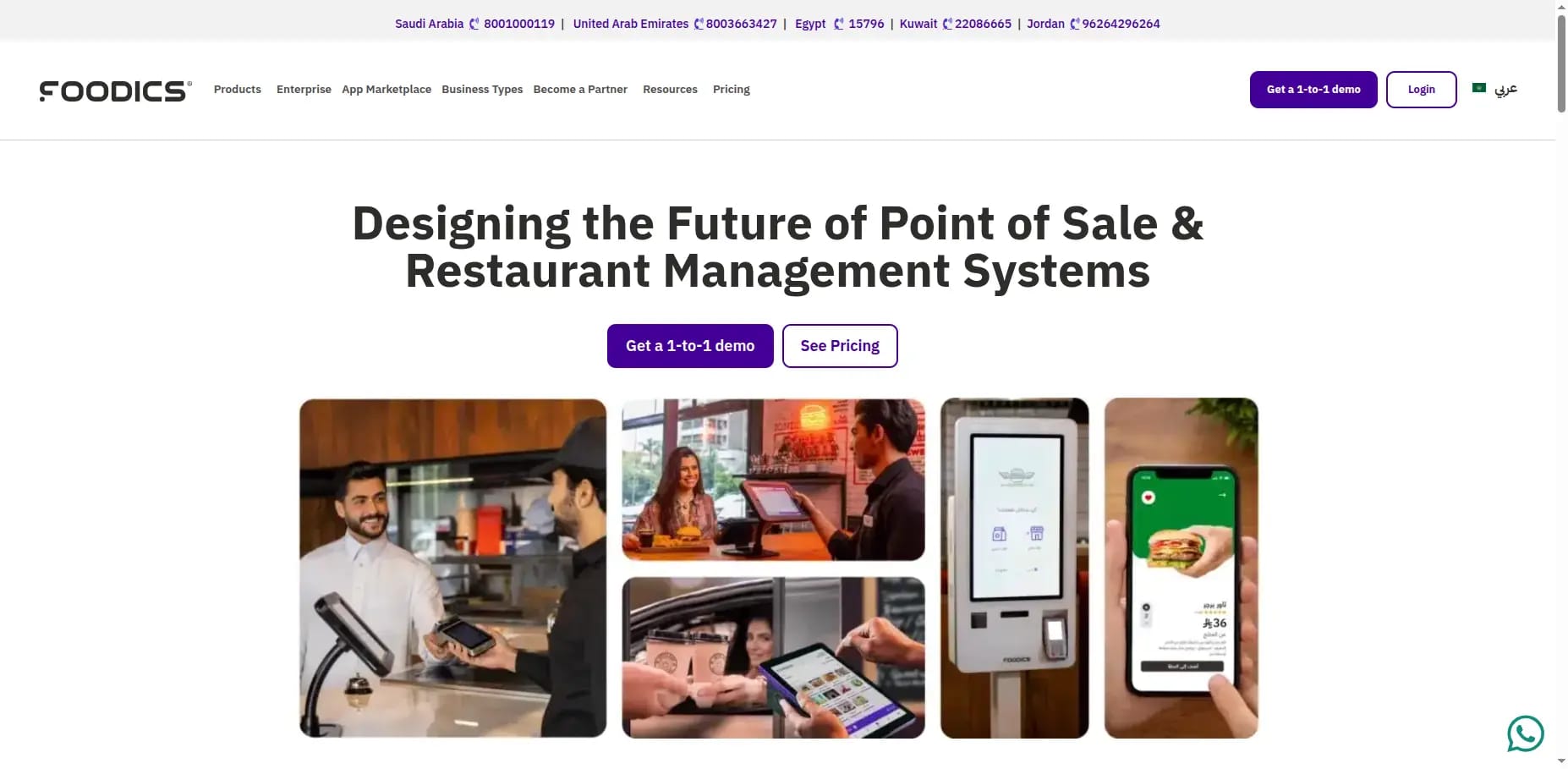
Point of Sale
iPad-based cashier app with offline mode, table management, split bills, QR ordering, and waiter-side ordering on mobile devices.
Inventory Management
Real-time stock tracking with recipe-level depletion, low-stock alerts, purchase orders, and multi-location transfer management.
Kitchen Display System
Digital order routing to kitchen stations, priority queuing, prep time tracking, and bump-bar support for high-volume kitchens.
Customer Relationship
Built-in loyalty programs, customer purchase history, segmented marketing, and feedback collection tied directly to transaction data.
Delivery Integration
Native integrations with HungerStation, Jahez, Marsool, and Talabat through FeedUs and Blend middleware. Auto menu sync and stock depletion.
HR & Payroll
Employee scheduling, attendance tracking via POS clock-in, payroll calculations with GOSI compliance, and labor cost reporting per branch.
The breadth is genuinely impressive. Most competitors in the MENA region offer two or three of these modules and rely on third-party integrations for the rest. Foodics builds (or acquires) nearly everything in-house.
POS & Cashier App: The iPad-First Experience
The cashier interface is where staff spend most of their time, so it needs to be fast, intuitive, and reliable. Foodics delivers on two out of three -- with one significant caveat.
The POS runs exclusively on iPads. There is no Android version, no Windows client, and no browser-based fallback. If your restaurant uses Android tablets or Windows terminals, Foodics is not an option unless you invest in Apple hardware. For a deeper look at the Foodics ecosystem and its strategic direction, see our Foodics review.
- Offline mode that caches transactions locally and syncs automatically when connectivity returns -- critical for Saudi malls where WiFi can be unreliable.
- Waiter app on iPhone for tableside ordering, reducing trips to the main POS terminal and speeding up service during peak hours.
- QR code ordering that lets customers scan, browse the menu, and place orders directly from their table without downloading an app.
- Pay-at-table functionality with integrated payment terminals, eliminating the need for customers to queue at the cashier.
- Multi-language interface supporting Arabic, English, French, and Turkish -- essential for restaurants with diverse staff in the Gulf region.
In our testing, the POS interface was responsive and well-organized. Menu navigation is logical, modifier handling is smooth, and the split-bill feature works without friction. The offline mode held up during a simulated connectivity drop, with all cached transactions syncing correctly once WiFi returned.
The iPad-only requirement is Foodics' biggest hardware limitation. A single iPad starts at SAR 1,499 in Saudi Arabia. For a multi-terminal restaurant, the hardware cost adds up quickly before you even pay for the software subscription.
Inventory Management: Real-Time Stock Control Across Locations
Inventory is where many restaurant POS systems fall apart. Foodics treats it as a first-class feature rather than an afterthought.
- Real-time stock tracking that updates the moment a sale is processed at the POS, not at end-of-day reconciliation.
- Recipe-level depletion: when a burger sells, the system automatically deducts the bun, patty, lettuce, and sauce from raw inventory based on predefined recipes.
- Low-stock alerts with configurable thresholds per ingredient, per location. Alerts can trigger automatic purchase orders to suppliers.
- Multi-location stock transfers with approval workflows, so a central kitchen can push ingredients to branches based on demand forecasts.
For restaurants managing complex supply chains, this level of granularity is valuable. Our restaurant management systems guide covers broader options, but Foodics is one of the few platforms where inventory is deeply integrated with the POS rather than bolted on.
The one weakness is reporting. While the raw data is comprehensive, the built-in inventory reports lack the visual depth you get from dedicated inventory tools. Power users will likely export data to spreadsheets for deeper analysis.
Delivery Integration: HungerStation, Jahez, Marsool & More
Delivery is no longer optional for Saudi restaurants. Foodics connects to the major Saudi delivery platforms through middleware layers rather than direct API integrations.
The integration works through FeedUs and Blend, two middleware platforms that sit between Foodics and the delivery apps. This means orders from HungerStation, Jahez, Marsool, and Talabat flow directly into the Foodics POS without manual re-entry. For context on how delivery platforms are reshaping the Saudi F&B market, see our related analyses.
| Delivery Platform | Integration Method | Auto Menu Sync | Stock Depletion |
|---|---|---|---|
| HungerStation | FeedUs middleware | Yes | Yes |
| Jahez | FeedUs middleware | Yes | Yes |
| Marsool | Blend middleware | Yes | Yes |
| Talabat | Blend middleware | Yes | Partial |
The middleware approach has a tradeoff: it adds a dependency layer. If FeedUs or Blend experience downtime, delivery orders stop flowing into the POS even though the delivery platforms themselves are still operational. In practice, we experienced no downtime during our testing period, but it is a risk worth noting.
Menu sync is the standout feature. When you update a price or mark an item out of stock in Foodics, the change propagates to all connected delivery platforms within minutes. This eliminates the painful process of logging into each delivery dashboard separately to update menus.
ZATCA Phase 2 Compliance: E-Invoicing Without the Headache
For Saudi-based restaurants, ZATCA compliance is not optional -- it is a legal requirement. Foodics has invested heavily in making Phase 2 e-invoicing as painless as possible.
- Phase 2 cryptographic stamps (QR codes) embedded in every invoice, generated automatically at the point of sale without manual intervention.
- Universally Unique Identifier (UUID) assigned to each invoice for tamper-proof audit trails as required by ZATCA regulations.
- Real-time reporting to ZATCA servers with automatic retry logic if the initial transmission fails due to connectivity issues.
- InvoiceQ integration for B2B invoicing scenarios, supporting the XML format required for business-to-business transactions under ZATCA Phase 2.
This is one area where Foodics has a clear advantage over international competitors. Platforms like Square or Toast have no ZATCA support at all -- Saudi restaurants using those systems need expensive third-party plugins or manual workarounds. For businesses also evaluating ERP-level compliance, our Odoo ZATCA compliance guide covers the broader landscape.
ZATCA Phase 2 enforcement is actively expanding across taxpayer waves. Restaurants that are not compliant risk penalties starting at SAR 5,000 per non-compliant invoice. Foodics generates compliant invoices by default -- no configuration required beyond the initial ZATCA registration.
Try Foodics for Your Restaurant
See why 30,000+ restaurants across the Middle East trust Foodics.
Request a Free DemoPricing Plans: What Foodics Actually Costs in 2026
Foodics uses a tiered subscription model billed annually. The published pricing covers the software license per cashier device -- hardware, delivery integration add-ons, and additional modules cost extra.
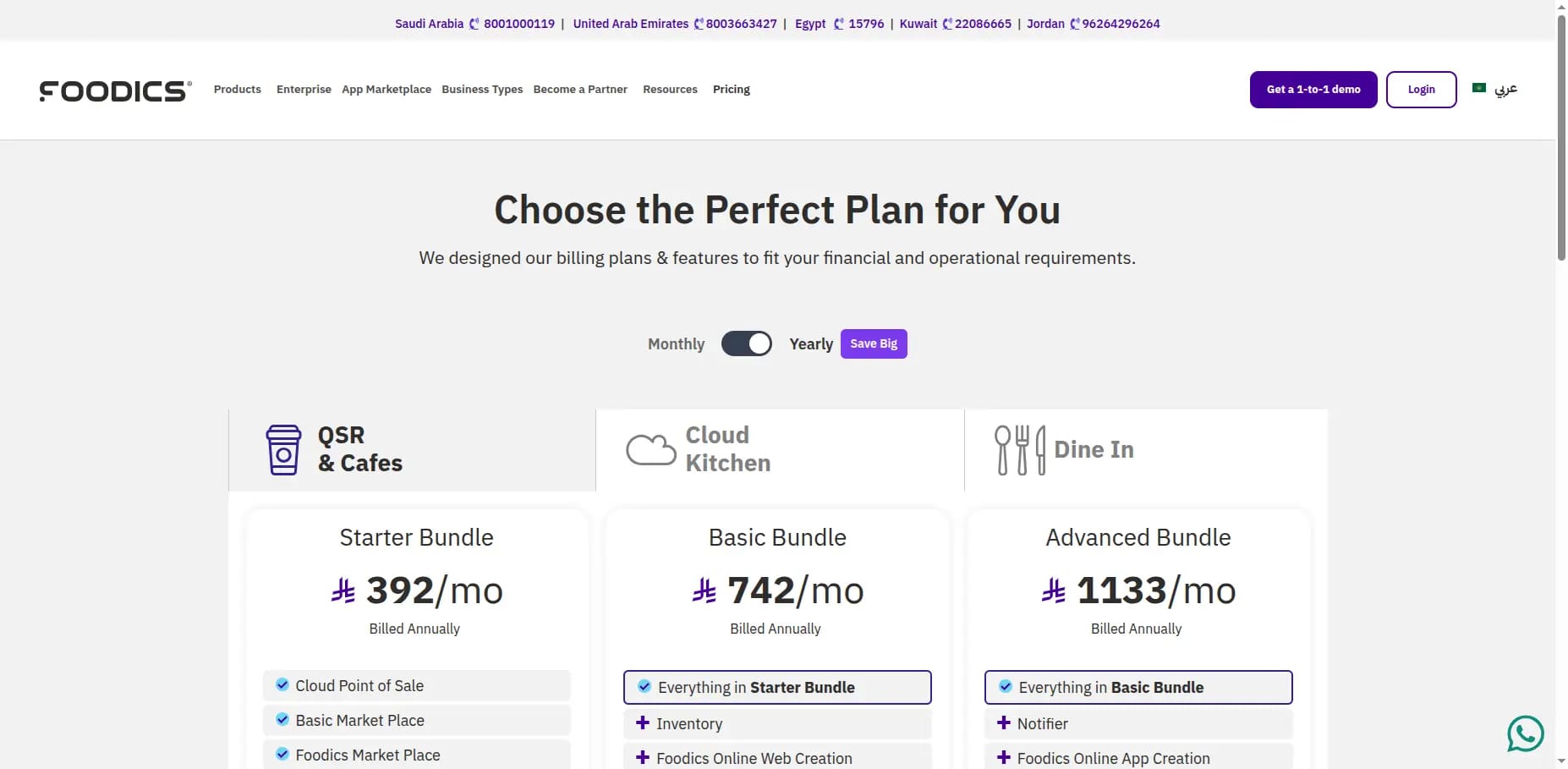
| Plan | Monthly (SAR) | Best For | Key Features |
|---|---|---|---|
| QSR Starter | SAR 392/mo | Single-location QSRs, food trucks | POS, basic inventory, ZATCA compliance, 1 device |
| Basic | SAR 742/mo | Full-service restaurants, small chains | Everything in Starter + KDS, CRM, table management, reporting |
| Advanced | SAR 1,133/mo | Multi-branch franchises, enterprise | Everything in Basic + multi-location, HR/payroll, advanced analytics, API access |
These are per-device prices on annual billing. A three-terminal restaurant on the Advanced plan pays SAR 3,399 per month in software alone -- before adding delivery integration (SAR 200-400/mo per platform) and hardware costs.
The pricing is competitive for what you get, but it scales up fast. For a detailed look at how POS subscription fees compound over time, see our analysis on POS subscription costs. Foodics does not publish discounts for multi-year commitments, though enterprise customers report negotiating 15-20% off published rates.
Pros and Cons: The Honest Breakdown
✅ What Foodics Gets Right
- All-in-one platform eliminates the need for 5-7 separate vendor relationships. POS, inventory, KDS, CRM, delivery, and HR in a single login.
- Deep MENA localization with Arabic-first interface, SAR pricing, bilingual receipt generation, and Gulf-specific tax configurations.
- ZATCA Phase 2 compliance built into every invoice by default -- no plugins, no manual configuration, no third-party dependencies.
- Delivery API integrations with HungerStation, Jahez, and Marsool through FeedUs/Blend, including automatic menu sync and stock depletion.
- Robust offline mode that caches transactions locally and syncs reliably when connectivity returns, tested in our four-week evaluation.
❌ Where Foodics Falls Short
- iPad-only POS client. No Android, no Windows, no browser-based option. This locks you into Apple hardware costs that can exceed SAR 6,000 for a multi-terminal setup.
- Pricing scales aggressively. A three-branch restaurant with delivery integration can easily exceed SAR 5,000/month in software fees alone.
- Complex initial setup. Multi-location inventory rules, recipe definitions, and delivery platform connections require dedicated onboarding time -- Foodics estimates 2-4 weeks for full deployment.
The pros heavily outweigh the cons for most Saudi restaurant operators. The iPad limitation is the most frustrating constraint because it is a deliberate product decision, not a technical limitation. Foodics has the engineering resources to build an Android client -- they have chosen not to.
Who Should Use Foodics?
Foodics is not for everyone. It is overbuilt for a single food truck and overpriced for a home bakery. But for specific operator profiles, it is the strongest option in the MENA market.
Multi-Branch Franchises
Centralized inventory, unified reporting across locations, and branch-level P&L analysis make Foodics the default choice for franchise operations with 3+ locations in Saudi Arabia.
Delivery-Heavy Restaurants
If 40%+ of your revenue comes from delivery platforms, the automated order flow and stock depletion across HungerStation, Jahez, and Marsool justifies the subscription cost.
Data-Driven Operators
Operators who want real-time sales analytics, labor cost tracking, and ingredient-level food cost reporting will find Foodics' data layer significantly deeper than competitors.
ZATCA Compliance Priority
Businesses that need guaranteed Phase 2 compliance without third-party dependencies or manual workarounds. Foodics generates compliant invoices by default from day one.
If you are a single-location cafe doing under SAR 30,000 in monthly revenue, Foodics is likely more platform than you need. A simpler POS like Loyverse or Square (where available) would serve you at a fraction of the cost.
Foodics vs Square vs POSRocket vs iiko: How They Compare
Choosing a restaurant POS in Saudi Arabia comes down to a handful of realistic options. Here is how Foodics stacks up against the most relevant competitors. For broader CRM and ERP comparisons, see our related guides.
| Feature | Foodics | Square | POSRocket | iiko |
|---|---|---|---|---|
| ZATCA Phase 2 | Built-in | Not supported | Built-in | Via partner |
| Saudi Delivery Apps | HungerStation, Jahez, Marsool | Limited | HungerStation, Jahez | Custom integration |
| Offline Mode | Full POS offline | Limited offline | Basic offline | Full offline |
| Hardware | iPad only | iPad, Android, Square Terminal | iPad, Android | Windows, Android, proprietary |
| Starting Price | SAR 392/mo | Free (+ processing fees) | SAR 299/mo | Custom quote |
| Arabic Interface | Native | Limited | Native | Partial |
| Multi-Location | Advanced (central kitchen, transfers) | Basic | Moderate | Enterprise-grade |
| Embedded Finance | Foodics Capital (SAMA licensed) | Square Capital (US only) | None | None |
Square offers the lowest entry cost but lacks ZATCA compliance and deep Saudi delivery integrations. POSRocket was a strong local competitor until Foodics acquired it in 2023 -- it continues to operate independently but product development has slowed. iiko targets enterprise-scale operations with complex kitchen workflows but requires significant customization and lacks native MENA localization.
For Saudi restaurants that need ZATCA compliance, delivery integration, and Arabic-first design, Foodics remains the most complete option. The iPad-only constraint and higher pricing are the main reasons operators look elsewhere.
Frequently Asked Questions
01Does Foodics integrate with HungerStation and Jahez for delivery orders?
Yes. Foodics connects to HungerStation and Jahez through FeedUs middleware, and to Marsool and Talabat through Blend middleware. Orders flow directly into the POS with automatic menu sync and stock depletion. There is no need to re-enter delivery orders manually.
02Is Foodics ZATCA Phase 2 compliant?
Yes. Foodics generates ZATCA Phase 2 compliant invoices by default, including cryptographic stamps, UUID assignment, and real-time reporting to ZATCA servers. B2B invoicing is supported through InvoiceQ integration. No third-party plugins are required.
03Does Foodics work on Android tablets?
No. The Foodics cashier app runs exclusively on iPads. There is no Android, Windows, or browser-based version. The waiter app runs on iPhones. If your restaurant uses Android hardware, you will need to either switch to iPads or consider alternatives like POSRocket or Square.
04How much does Foodics cost for a multi-branch restaurant?
Pricing depends on the plan and number of devices. A three-terminal restaurant on the Advanced plan pays approximately SAR 3,399/month in software fees. Add delivery integration (SAR 200-400/month per platform) and iPad hardware costs. Enterprise customers can negotiate 15-20% off published rates.
05Does Foodics include HR and payroll features?
Yes, on the Advanced plan. Features include employee scheduling, POS-based clock-in/clock-out, payroll calculations with GOSI compliance, and labor cost reporting per branch. The Starter and Basic plans do not include HR/payroll modules.
 Our Verdict
Final Verdict: 4.5 / 5
Foodics earns a 4.5 out of 5 as the most complete restaurant management platform available in Saudi Arabia and the broader MENA region. The all-in-one approach eliminates vendor sprawl, ZATCA compliance is seamless, and delivery integrations work as advertised.
The half-point deduction comes from two persistent issues: the iPad-only hardware requirement adds unnecessary cost for operators who already own Android or Windows terminals, and the pricing scales aggressively for multi-branch operations. These are not dealbreakers, but they are real costs that affect the total value proposition.
For Saudi restaurants doing SAR 50,000+ in monthly revenue with delivery exposure and multi-location ambitions, Foodics is our recommended choice. The platform depth, ZATCA compliance, and delivery integrations create a combination that no single competitor currently matches in the MENA market.
Our Pick for Saudi Restaurants
Foodics scores 4.5/5 -- the most complete restaurant platform for the MENA region.
Try Foodics Free